

Forum Replies Created
-
AuthorPosts
-
shahkb4
KeymasterSolution
line $L_{1} \frac{x-2}{-3}=\frac{y-6}{2}=\frac{z-7}{4}=\lambda_{1}$
line $\mathrm{L}_{2} \frac{\mathrm{x}-4}{2}=\frac{\mathrm{y}-3}{1}=\frac{\mathrm{z}-5}{3}=\lambda_{2}$
Point $\mathrm{C}\left(-3 \lambda_{1}+2,2 \lambda_{1}+6,4 \lambda_{1}+7\right)$ on line $\mathrm{L}_{1}$
Point $\mathrm{D}\left(2 \lambda_{2}+4, \lambda_{2}+3,3 \lambda_{2}+5\right)$ on line $\mathrm{L}_{2}$
 \[ \begin{aligned} & \mathrm{CD} \xrightarrow{\mathrm{drs}} 2 \lambda_{2}+3 \lambda_{1}+2, \lambda_{2}-2 \lambda_{1}-3,3 \lambda_{2}-4 \lambda_{1}-2 \\ & \quad \text { or }-3,5,16 \\ & \frac{2 \lambda_{2}+3 \lambda_{1}+2}{-3}=\frac{\lambda_{2}-2 \lambda_{1}-3}{5}=\frac{3 \lambda_{2}-4 \lambda_{1}-2}{16} \end{aligned} \]
From first \& middle
$10 \lambda_{2}+15 \lambda_{1}+10=-3 \lambda_{2}+6 \lambda_{1}+9$
$\Rightarrow 13 \lambda_{2}+9 \lambda_{1}+1=0$
From middle \& third
$16 \lambda_{2}-32 \lambda_{1}-48=15 \lambda_{2}-20 \lambda_{1}-10$
$\Rightarrow \lambda_{2}=12 \lambda_{1}+38$
$13\left(12 \lambda_{1}+38\right)+9 \lambda_{1}+1=0$
$\Rightarrow 165 \lambda_{1}+495=0 \Rightarrow \lambda_{1}=-3$
$\Rightarrow \lambda_{2}=-36+38 \Rightarrow \lambda_{2}=2$ Ans.
$\lambda_{1}=-3, \lambda_{2}=2$
we get $\mathrm{C}(11,0,-5) \mathrm{D}(8,5,11)$
$\mathrm{CD}^{2}=9+25+256=290$ Answer(2)KeymasterSolution
\[ \begin{aligned} & \alpha=\beta=\gamma \\ & \cos ^{2} \alpha+\cos ^{2} \beta+\cos ^{2} \gamma=1 \\ & \Rightarrow 3 \cos ^{2} \alpha=1 \Rightarrow \cos \alpha=\frac{1}{\sqrt{3}} \end{aligned} \]direction ratios $\rightarrow 1,1,1$
line $\frac{x+3}{1}=\frac{y-5}{1}=\frac{z-2}{1}=\lambda$
$\mathrm{B}(\lambda-3, \lambda+5, \lambda+2)$
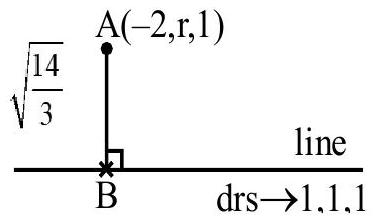
$\mathrm{AB} \xrightarrow{\text { drs }} \lambda-3+2, \lambda+5-\mathrm{r}, \lambda+2-1$ or $\lambda-1, \lambda+5-\mathrm{r}, \lambda+1$
line $\xrightarrow{\text { drs }} 1,1,1$
line $\perp \mathrm{AB} \Rightarrow(\lambda-1) 1+(\lambda+5-\mathrm{r}) 1+(\lambda+1) 1=0$
$\Rightarrow \lambda=\frac{\mathrm{r}-5}{3}$
$\mathrm{B}(\lambda-3, \lambda+5, \lambda+2) \equiv\left(\frac{\mathrm{r}-14}{3}, \frac{\mathrm{r}+10}{3}, \frac{\mathrm{r}+1}{3}\right)$
A(-2,r,1)
$\mathrm{AB}^{2}=\frac{14}{3} \Rightarrow\left(\frac{\mathrm{r}-14}{3}+2\right)^{2}+\left(\frac{\mathrm{r}+10}{3}-\mathrm{r}\right)^{2}+\left(\frac{\mathrm{r}+1}{3}-1\right)^{2}=\frac{14}{3}$
$\Rightarrow\left(\frac{\mathrm{r}-8}{3}\right)^{2}+\left(\frac{10-2 \mathrm{r}}{3}\right)^{2}+\left(\frac{\mathrm{r}-2}{3}\right)^{2}=\frac{14}{3}$
$\Rightarrow \mathrm{r}^{2}+64-16 \mathrm{r}+100+4 \mathrm{r}^{2}-40 \mathrm{r}+\mathrm{r}^{2}-4 \mathrm{r}+4=14 \times 3=42$
$\Rightarrow 6 \mathrm{r}^{2}-60 \mathrm{r}+12 \mathrm{r}=0 \Rightarrow \mathrm{r}^{2}-10 \mathrm{r}+21=0$
$\Rightarrow(\mathrm{r}-7)(\mathrm{r}-3)=0 \Rightarrow \mathrm{r}=7,3$ Sum $=10$ Answer(4)KeymasterSolution
let point B on given line
$\mathrm{B}(2 \lambda-1,3 \lambda+3,1-\lambda)$
$\mathrm{AB} \xrightarrow{\mathrm{drs}} 2 \lambda-1-5,3 \lambda+3-4,1-\lambda-2$
or $2 \lambda-6,3 \lambda-1,-\lambda-1$

line $\xrightarrow{\text { drs }} 2,3,-1$
$\mathrm{AB} \perp$ line
$2(2 \lambda-6)+3(3 \lambda-1)-1(-\lambda-1)=0$
$\Rightarrow 4 \lambda-12+9 \lambda-3+\lambda+1=0 \Rightarrow 14 \lambda=14 \Rightarrow \lambda=1$
$\mathrm{B}(1,6,0) \equiv(\alpha, \beta, \gamma)$
$\alpha=1, \beta=6, \gamma=0$
required length of Projection\[ =\frac{|(\alpha \hat{i}+\beta \hat{j}+\gamma \hat{k}) \cdot(6 \hat{i}+2 \hat{j}+3 \hat{k})|}{\sqrt{36+4+9}}=\left|\frac{6 \alpha+2 \beta+3 \gamma}{7}\right|=\frac{6+12+0}{7}=\frac{18}{7} \text { Answer }(3) \]KeymasterSolution
As P is equidistant from lines AB and AC . It means P lies on angle bisector $\angle \mathrm{BAC}$
\[ \cos 2 \theta=\frac{\overrightarrow{\mathrm{AB}} \cdot \overrightarrow{\mathrm{AC}}}{|\overrightarrow{\mathrm{AB}} \| \overrightarrow{\mathrm{AC}}|}=\frac{(3 \hat{\imath}+\hat{\jmath}-\hat{k}) \cdot(\hat{\imath}-\hat{\jmath}+3 \hat{k})}{\sqrt{9+1+1} \sqrt{1+1+9}} \]\[ \begin{aligned} & \Rightarrow \cos 2 \theta=\frac{3-1-3}{11}=-\frac{1}{11} \\ & \Rightarrow 1-2 \sin ^{2} \theta=-\frac{1}{11} \Rightarrow \sin \theta=\sqrt{\frac{6}{11}} \\ & \text { area of } \begin{aligned} \Delta \mathrm{ABP} & =\frac{1}{2}(\mathrm{AB})(\mathrm{AP}) \sin \theta \\ & =\frac{1}{2} \sqrt{9+1+1}\left(\frac{\sqrt{5}}{2}\right) \sqrt{\frac{6}{11}} \\ & =\frac{1}{2} \times \frac{\sqrt{5}}{2} \sqrt{6}=\frac{\sqrt{30}}{4} \text { Answer }(3) \end{aligned} \end{aligned} \]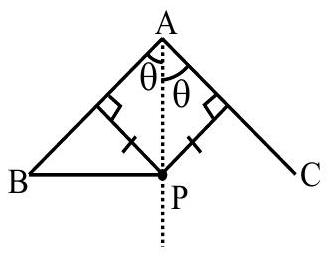 Keymaster
Solution
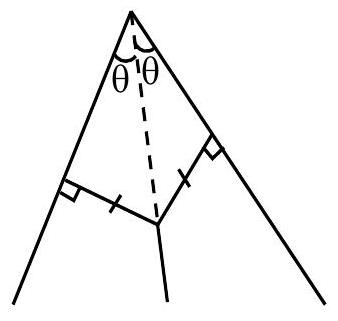
Point S which is equidistant from lines PQ and PR , lies on angle bisector of $\angle \mathrm{QPR}$
$|\overrightarrow{\mathrm{PR}}|=\sqrt{\mathrm{a}^{2}+\mathrm{b}^{2}+16}=9$
$\Rightarrow \mathrm{a}^{2}+\mathrm{b}^{2}+16=81$
$\Rightarrow \mathrm{a}^{2}+\mathrm{b}^{2}=65$
$|\overrightarrow{\mathrm{PQ}}|=\sqrt{4+1+4}=3$
S divides QR in $1: 3$ ratio
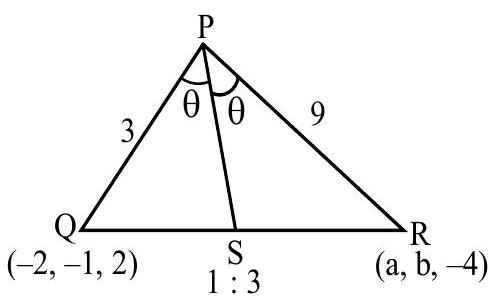
$\mathrm{S}\left(\frac{\mathrm{a}-6}{4}, \frac{\mathrm{~b}-3}{4}, \frac{1}{2}\right)$
$\overrightarrow{\mathrm{PS}}=\frac{(\mathrm{a}-6) \hat{\mathrm{i}}}{4}+\frac{(\mathrm{b}-3) \hat{\mathrm{j}}}{4}+\frac{\hat{\mathrm{k}}}{2}$
$\overrightarrow{\mathrm{PS}}=\frac{\hat{\imath}-7 \hat{\mathrm{j}}+2 \hat{k}}{4}=\frac{(\mathrm{a}-6) \hat{\mathrm{i}}+(\mathrm{b}-3) \hat{\mathrm{j}}+2 \hat{k}}{4}$
We get $a=7, b=-4$
$3 a-4 b=3(7)-4(-4)=21+16=37$ Answer(37)KeymasterSolution
$\because|\overrightarrow{\mathrm{a}}|=|\overrightarrow{\mathrm{b}}|=|\overrightarrow{\mathrm{c}}|=1$
As given $|\vec{a}-\vec{b}|^{2}+|\vec{b}-\vec{c}|^{2}+|\vec{c}-\vec{a}|^{2}=9$
$\Rightarrow|\overrightarrow{\mathrm{a}}|^{2}+|\overrightarrow{\mathrm{b}}|^{2}-2 \overrightarrow{\mathrm{a}} \cdot \overrightarrow{\mathrm{b}}+|\overrightarrow{\mathrm{b}}|^{2}+|\overrightarrow{\mathrm{c}}|^{2}-2 \overrightarrow{\mathrm{~b}} \cdot \overrightarrow{\mathrm{c}}+|\overrightarrow{\mathrm{c}}|^{2}+|\overrightarrow{\mathrm{a}}|^{2}-2 \overrightarrow{\mathrm{c}} \cdot \overrightarrow{\mathrm{a}}=9$
$\Rightarrow 1+1-2 \vec{a} \cdot \vec{b}+1+1-2 \vec{b} \cdot \vec{c}+1+1-2 \vec{c} \cdot \vec{a}=9$
$\Rightarrow \overrightarrow{\mathrm{a}} \cdot \overrightarrow{\mathrm{b}}+\overrightarrow{\mathrm{b}} \cdot \overrightarrow{\mathrm{c}}+\overrightarrow{\mathrm{c}} \cdot \overrightarrow{\mathrm{a}}=-\frac{3}{2}$
$\because|\vec{a}+\vec{b}+\vec{c}|^{2}=|\vec{a}|^{2}+|\vec{b}|^{2}+|\vec{c}|^{2}+2(\vec{a} \cdot \vec{b}+\vec{b} \cdot \vec{c}+\vec{c} \cdot \vec{a})$
$=1+1+1+2\left(-\frac{3}{2}\right)=0$
$\overrightarrow{\mathrm{a}}+\overrightarrow{\mathrm{b}}+\overrightarrow{\mathrm{c}}=0$
$|2 \overrightarrow{\mathrm{a}}+\mathrm{k}(\overrightarrow{\mathrm{b}}+\overrightarrow{\mathrm{c}})|=3$
$\Rightarrow|2 \overrightarrow{\mathrm{a}}-\overrightarrow{\mathrm{a}} \mathrm{k}|=3 \Rightarrow|\overrightarrow{\mathrm{a}} \|(2-\mathrm{k})|=3$
$\Rightarrow 2-\mathrm{k} \mid=3 \Rightarrow 2-\mathrm{k}= \pm 3$
we get $\mathrm{k}=-1 ; \mathrm{k}=5$ Answer(4)KeymasterSolution
$2 \vec{a} \times \vec{c}+3 \vec{b} \times \vec{c}=0 \Rightarrow(2 \vec{a}+3 \vec{b}) \times \vec{c}=0$
$\Rightarrow \vec{c} \| 2 \vec{a}+\overrightarrow{3 b} \Rightarrow \vec{c}=\lambda(2 \vec{a}+3 \vec{b})$
$\Rightarrow \overrightarrow{\mathrm{c}}=\lambda(2(2 \hat{\mathrm{i}}-5 \hat{\mathrm{j}}+5 \hat{\mathrm{k}})+3(\hat{\mathrm{i}}-\hat{\mathrm{j}}+3 \hat{\mathrm{k}}))$
$\Rightarrow \overrightarrow{\mathrm{c}}=\lambda(7 \hat{\mathrm{i}}-13 \hat{\mathrm{j}}+19 \hat{\mathrm{k}})$
$(\vec{a}-\vec{b}) \cdot \vec{c}=(\hat{i}-4 \hat{j}+2 \hat{k}) \cdot \lambda(7 \hat{i}-13 \hat{j}+19 \hat{k})=-97$
$\Rightarrow \lambda(7+52+38)=-97 \Rightarrow \lambda=-1$
$\overrightarrow{\mathrm{c}}=-7 \hat{\mathrm{i}}+13 \hat{\mathrm{j}}-19 \hat{\mathrm{k}}$
$\overrightarrow{\mathrm{c}} \times \hat{\mathrm{k}}=-7 \hat{\mathrm{i}} \times \hat{\mathrm{k}}+13 \hat{\mathrm{j}} \times \hat{\mathrm{k}}-19 \hat{\mathrm{k}} \times \hat{\mathrm{k}}$
$\Rightarrow \overrightarrow{\mathrm{c}} \times \hat{\mathrm{k}}=7 \hat{\mathrm{j}}+13 \hat{\mathrm{i}}-0$
$|\overrightarrow{\mathrm{c}} \times \hat{\mathrm{k}}|^{2}=49+169=218$ Answer(3)KeymasterSolution
Any vector $\overrightarrow{\mathrm{v}}$ in plane of $\overrightarrow{\mathrm{a}} \& \overrightarrow{\mathrm{~b}}$
\[ \begin{aligned} & \vec{v}=x \vec{a}+y \vec{b}=x(2 \hat{\imath}-\hat{j}-\hat{k})+y(\hat{\imath}+3 \hat{j}-\hat{k}) \\ & \Rightarrow \vec{v}=(2 x+y) \hat{\imath}+(3 y-x) \hat{j}-(x+y) \hat{k} \end{aligned} \]Projection length $\vec{v}$ on $\vec{c}=\frac{|\dot{v} \cdot \vec{c}|}{|\vec{c}|}=\frac{1}{\sqrt{14}}$
$\Rightarrow \frac{|2(2 x+y)+1(3 y-x)-7(x+y)|}{\sqrt{4+1+9}}=\frac{1}{\sqrt{14}}$
$\Rightarrow|4 x+2 y+3 y-x-3 x-3 y|=1$
$\Rightarrow|2 \mathrm{y}|=1 \Rightarrow \mathrm{y}= \pm \frac{1}{2}$
$|\overrightarrow{\mathrm{V}}|=\sqrt{(2 \mathrm{x}+\mathrm{y})^{2}+(3 \mathrm{y}-\mathrm{x})^{2}+(\mathrm{x}+\mathrm{y})^{2}}$
$=\sqrt{4 x^{2}+y^{2}+4 x y+9 y^{2}+x^{2}-6 x y+x^{2}+y^{2}+2 x y}$
$=\sqrt{6 x^{2}+11 y^{2}}=\sqrt{6 x^{2}+\frac{11}{4}}=\frac{\sqrt{24 x^{2}+11}}{2}$
(1) $\frac{\sqrt{24 x^{2}+11}}{2}=\frac{\sqrt{21}}{2} \Rightarrow 24 x^{2}+11=21$
$\Rightarrow \mathrm{x}^{2}=\frac{10}{24} \Rightarrow \mathrm{x}= \pm \sqrt{\frac{5}{12}}$
(2) $\frac{\sqrt{24 \mathrm{x}^{2}+11}}{2}=13 \Rightarrow 24 \mathrm{x}^{2}+11=169 \times 4$
$\Rightarrow \mathrm{x} \approx \pm 5.26$
(3) $\frac{\sqrt{24 x^{2}+11}}{2}=\frac{\sqrt{35}}{2} \Rightarrow x=1$
(4) $\frac{\sqrt{24 \mathrm{x}^{2}+11}}{2}=7 \Rightarrow 24 \mathrm{x}^{2}+11=4 \times 49$
$\Rightarrow \mathrm{x} \approx \pm 2.27$ Answer(1,2,3,4)KeymasterSolution
\[ \begin{aligned} & \overrightarrow{\mathrm{c}}=\overrightarrow{\mathrm{a}} \times \overrightarrow{\mathrm{b}}=\left|\begin{array}{ccc} \hat{\mathrm{i}} & \hat{\mathrm{j}} & \hat{\mathrm{k}} \\ 2 & 1 & -2 \\ 1 & 1 & 0 \end{array}\right|=2 \hat{\mathrm{i}}-2 \hat{\mathrm{j}}+\hat{\mathrm{k}} \\ & |\overrightarrow{\mathrm{c}}|=\sqrt{4+4+1}=3 \\ & |\overrightarrow{\mathrm{c}} \times \overrightarrow{\mathrm{d}}|=|\overrightarrow{\mathrm{c}} \| \overrightarrow{\mathrm{d}}| \sin \frac{\pi}{4}=3 \\ & \Rightarrow 3|\overrightarrow{\mathrm{~d}}| \frac{1}{\sqrt{2}}=3 \Rightarrow|\overrightarrow{\mathrm{~d}}|=\sqrt{2} \\ & \operatorname{given}|\overrightarrow{\mathrm{~d}}-\overrightarrow{\mathrm{a}}|=\sqrt{11} \Rightarrow(\overrightarrow{\mathrm{~d}}-\overrightarrow{\mathrm{a}})^{2}=11 \\ & \Rightarrow|\overrightarrow{\mathrm{~d}}|^{2}+|\overrightarrow{\mathrm{a}}|^{2}-2 \overrightarrow{\mathrm{~d}} \cdot \overrightarrow{\mathrm{a}}=11 \\ & \Rightarrow 2+(4+1+4)-2 \overrightarrow{\mathrm{~d}} \cdot \overrightarrow{\mathrm{a}}=11 \\ & \Rightarrow \overrightarrow{\mathrm{~d}} \cdot \overrightarrow{\mathrm{a}}=\overrightarrow{\mathrm{a}} \cdot \overrightarrow{\mathrm{~d}}=0 \text { Answer }(3) \end{aligned} \]KeymasterSolution
$\overrightarrow{\mathrm{a}} \times \overrightarrow{\mathrm{b}}=2 \overrightarrow{\mathrm{a}} \times \overrightarrow{\mathrm{c}} \Rightarrow \overrightarrow{\mathrm{a}} \times \overrightarrow{\mathrm{b}}-\overrightarrow{\mathrm{a}} \times(2 \overrightarrow{\mathrm{c}})=0$
$\Rightarrow \overrightarrow{\mathrm{a}} \times(\overrightarrow{\mathrm{b}}-2 \overrightarrow{\mathrm{c}})=0$
$\vec{a} \& \vec{b}-2 \vec{c}$ are parallel
$\overrightarrow{\mathrm{b}}-2 \overrightarrow{\mathrm{c}}=\lambda \overrightarrow{\mathrm{a}}$Square $(\vec{b}-2 \vec{c})^{2}=(\lambda \vec{a})^{2}$
$\Rightarrow|\overrightarrow{\mathrm{b}}|^{2}+4|\overrightarrow{\mathrm{c}}|^{2}-4 \overrightarrow{\mathrm{~b}} \cdot \overrightarrow{\mathrm{c}}=\lambda^{2}|\overrightarrow{\mathrm{a}}|^{2}$
$\Rightarrow 16+4(4)-4|\vec{b} \| \vec{c}| \cos 60^{\circ}=\lambda^{2}(1)$
$\Rightarrow 32-4(4)(2)\left(\frac{1}{2}\right)=\lambda^{2} \Rightarrow \lambda^{2}=16 \Rightarrow \lambda= \pm 4$
$\because \overrightarrow{\mathrm{b}}-2 \overrightarrow{\mathrm{c}}=\lambda \overrightarrow{\mathrm{a}}$ dot with $\overrightarrow{\mathrm{c}}$
$\overrightarrow{\mathrm{b}} \cdot \overrightarrow{\mathrm{c}}-2 \overrightarrow{\mathrm{c}} \cdot \overrightarrow{\mathrm{c}}=\lambda \overrightarrow{\mathrm{a}} \cdot \overrightarrow{\mathrm{c}}$
$\Rightarrow|\overrightarrow{\mathrm{b}} \| \overrightarrow{\mathrm{c}}| \cos 60^{\circ}-2|\overrightarrow{\mathrm{c}}|^{2}=\lambda(\overrightarrow{\mathrm{a}} \cdot \overrightarrow{\mathrm{c}})$
$\Rightarrow 4(2)\left(\frac{1}{2}\right)-2(4)=\lambda \overrightarrow{\mathrm{a}} . \overrightarrow{\mathrm{c}} \Rightarrow \lambda(\overrightarrow{\mathrm{a}} \cdot \overrightarrow{\mathrm{c}})=-4$
$\Rightarrow|\lambda||\overrightarrow{\mathrm{a}} \cdot \overrightarrow{\mathrm{c}}|=4 \Rightarrow|\overrightarrow{\mathrm{a}} \cdot \overrightarrow{\mathrm{c}}|=1$ Answer(KeymasterSolution
$\vec{v}=\vec{a} \times \vec{b}, \quad \vec{v} \cdot \vec{c}=(\vec{a} \times \vec{b}) \cdot \vec{c}=11$
$\Rightarrow[\overrightarrow{\mathrm{a}} \overrightarrow{\mathrm{b}} \overrightarrow{\mathrm{c}}]=11$
$\Rightarrow\left|\begin{array}{ccc}1 & -2 & 3 \\ 2 & 1 & -1 \\ \lambda & 1 & 1\end{array}\right|=1(1+1)+2(2+\lambda)+3(2-\lambda)=11$
$\Rightarrow-\lambda+12=11 \Rightarrow \lambda=1$
Required projection’s length of $\vec{b}$ on $\vec{c}=\left|\frac{\vec{b} \cdot \vec{c}}{|\vec{c}|}\right|$
$p=\left|\frac{(2 \hat{i}+\hat{j}-\hat{k}) \cdot(\hat{i}+\hat{j}+\hat{k})}{\sqrt{1+1+1}}\right|=\frac{2+1-1}{\sqrt{3}}=\frac{2}{\sqrt{3}}$
$\mathrm{p}^{2}=\frac{4}{3} \Rightarrow 9 \mathrm{p}^{2}=4 \times 3=12$ Answer(4)KeymasterSolution
$\vec{d}=\vec{c} \times \vec{a}=(\vec{a} \times \vec{b}) \times \vec{a}$
$\overrightarrow{\mathrm{d}}=-\overrightarrow{\mathrm{a}} \times(\overrightarrow{\mathrm{a}} \times \overrightarrow{\mathrm{b}})=-[(\overrightarrow{\mathrm{a}} \cdot \overrightarrow{\mathrm{b}}) \overrightarrow{\mathrm{a}}-(\overrightarrow{\mathrm{a}} \cdot \overrightarrow{\mathrm{a}}) \overrightarrow{\mathrm{b}}]$
$\overrightarrow{\mathrm{d}}=-[(-1-1-6) \overrightarrow{\mathrm{a}}-(1+1+4) \overrightarrow{\mathrm{b}}]$
$\overrightarrow{\mathrm{d}}=8 \overrightarrow{\mathrm{a}}+6 \overrightarrow{\mathrm{~b}}$
Now $(\vec{a}-\vec{b}) \cdot \vec{d}=(\vec{a}-\vec{b}) \cdot(8 \vec{a}+6 \vec{b})$
$=8 \vec{a} \cdot \vec{a}+6 \vec{a} \cdot \vec{b}-8 \vec{b} \cdot \vec{a}-6 \vec{b} \cdot \vec{b}=8|\vec{a}|^{2}-2 \vec{a} \cdot \vec{b}-6|\vec{b}|^{2}$
$=8(1+1+4)-2(-1-1-6)-6(1+1+9)$
$=48+16-66=-2$ Answer(3)KeymasterSolution
\[ \begin{aligned} & \vec{a}^{\wedge} \vec{b} \in\left(\frac{\pi}{2}, \pi\right) ; \vec{a} \cdot \vec{b}<0 \Rightarrow\left(-\lambda^{2} \sqrt{2}-4 \sqrt{2}+4 \sqrt{2} \lambda\right)<0 \\ & \Rightarrow-\sqrt{2}\left(\lambda^{2}+4-4 \lambda\right)<0 \Rightarrow(\lambda-2)^{2}>0 \Rightarrow \lambda \in R-\{2\} \quad \lambda \neq 2 \\ & \theta=\vec{a}^{\wedge} \hat{k} ; \cos \theta=\frac{\vec{a} \cdot \hat{k}}{|\vec{a}||\hat{k}|}=\frac{\lambda}{\sqrt{\lambda^{2}+3}} \\ & \frac{\pi}{6}<\theta<\frac{\pi}{2} \Rightarrow \cos \frac{\pi}{6}>\cos \theta>\cos \frac{\pi}{2} \end{aligned} \]$\Rightarrow \frac{\sqrt{3}}{2}>\frac{\lambda}{\sqrt{\lambda^{2}+3}}>0 ; \lambda>0$
$\Rightarrow \sqrt{3} \sqrt{\lambda^{2}+3}>2 \lambda$
$\Rightarrow 3 \lambda^{2}+9>4 \lambda^{2}=\lambda^{2}-9<0$
$\Rightarrow(\lambda-3)(\lambda+3)<0$
$\Rightarrow \lambda \in(-3,3)$
$(1) \cap(2) \cap(3)$
$\lambda \in(0,3)-\{2\}=(\alpha, \beta)-\{\gamma\}$
$\alpha=0 ; \beta=3 ; \gamma=2 \Rightarrow \alpha+\beta+\gamma=5$ Answer(5)KeymasterSolution
$\overrightarrow{\mathrm{c}}=\overrightarrow{\mathrm{a}} \times \hat{\mathrm{b}}=\left|\begin{array}{ccc}\hat{\lambda} & \hat{\mathrm{j}} & \hat{\mathrm{k}} \\ 2 & -1 & 1 \\ 0 & \lambda & 2\end{array}\right|=(-2-\lambda) \hat{\mathrm{i}}-4 \hat{\mathrm{j}}+2 \lambda \hat{\mathrm{k}}$
$|\overrightarrow{\mathrm{c}}|=\sqrt{53}=\sqrt{(-2-\lambda)^{2}+16+4 \lambda^{2}}$
$\Rightarrow 53=4+\lambda^{2}+4 \lambda+16+4 \lambda^{2}$
$\Rightarrow 5 \lambda^{2}+4 \lambda-33=0 \Rightarrow(5 \lambda-11)(\lambda+3)=0$
$\lambda=11 / 5$ (reject) $\lambda=-3$ (accept); $\lambda \in \mathrm{Z}$
$\overrightarrow{\mathrm{c}}=\hat{\mathrm{i}}-4 \hat{\mathrm{j}}-6 \hat{\mathrm{k}}$
let $\vec{d}=x \hat{i}+y \hat{j}+z \hat{k}$
$\overrightarrow{\mathrm{d}}$ lies in yz plane, $\mathrm{x}=0$
$\overrightarrow{\mathrm{d}}=y \hat{\mathrm{j}}+z \hat{\mathrm{k}}$
$|\overrightarrow{\mathrm{d}}|=2=\sqrt{\mathrm{y}^{2}+\mathrm{z}^{2}} \Rightarrow \mathrm{y}^{2}+\mathrm{z}^{2}=4$
$\overrightarrow{\mathrm{c}} \cdot \overrightarrow{\mathrm{d}}=|\overrightarrow{\mathrm{c}} \| \overrightarrow{\mathrm{d}}| \cos \theta$
$\Rightarrow(\overrightarrow{\mathrm{c}} \cdot \overrightarrow{\mathrm{d}})^{2}=|\overrightarrow{\mathrm{c}}|^{2}|\overrightarrow{\mathrm{~d}}|^{2} \cos ^{2} \theta \leq|\overrightarrow{\mathrm{c}}|^{2}|\overrightarrow{\mathrm{~d}}|^{2}$
$\Rightarrow(\overrightarrow{\mathrm{c}} \cdot \overrightarrow{\mathrm{d}})^{2} \leq(53)(4)=212$
Clearly $\overrightarrow{\mathrm{c}}$ \& $\overrightarrow{\mathrm{d}}$ are not parallel
It means $(\overrightarrow{\mathrm{c}} . \overrightarrow{\mathrm{d}})^{2}<212$
$\vec{c}=\hat{i}-4 \hat{j}-6 \hat{k} ; \vec{d}=y \hat{j}+z \hat{k}$
$\overrightarrow{\mathrm{c}} \cdot \overrightarrow{\mathrm{d}}=-4 \mathrm{y}-6 \mathrm{z}$
$\Rightarrow(4 y+6 z)^{2} \leq\left(\sqrt{4^{2}+6^{2}} \sqrt{y^{2}+z^{2}}\right)^{2}$
$\Rightarrow(\overrightarrow{\mathrm{c}} . \overrightarrow{\mathrm{d}})^{2} \leq(52)(4)=208$ Answer(3)KeymasterSolution
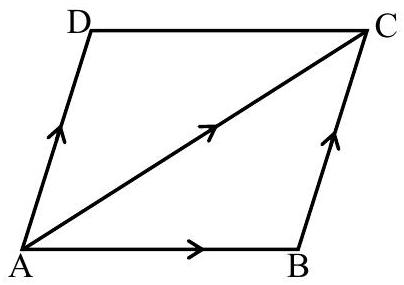
$\overrightarrow{\mathrm{AD}}=\overrightarrow{\mathrm{BC}}$
$\overrightarrow{\mathrm{AC}}=\overrightarrow{\mathrm{AB}}+\overrightarrow{\mathrm{BC}}=\overrightarrow{\mathrm{AB}}+\overrightarrow{\mathrm{AD}}$
$\overrightarrow{\mathrm{AC}}=3 \hat{\mathrm{i}}+6 \hat{\mathrm{j}}+(\lambda-5) \hat{\mathrm{k}}$
Projection of $\vec{V}$ on $\overrightarrow{A C}=\left|\frac{\vec{V} \cdot \overrightarrow{A C}}{|\overrightarrow{A C}|}\right|=1$
$\Rightarrow\left|\frac{3+6+\lambda-5}{\sqrt{9+36+(\lambda-5)^{2}}}\right|=1$
$\Rightarrow|\lambda+4|^{2}=\sqrt{\lambda^{2}-10 \lambda+70} \Rightarrow \lambda^{2}+16+8 \lambda=\lambda^{2}-10 \lambda+70$
$\Rightarrow 18 \lambda=54 \Rightarrow \lambda=3$
Now Quadratic Equation
$9 \mathrm{x}^{2}-18 \mathrm{x}+5=0 \Rightarrow 9 \mathrm{x}^{2}-3 \mathrm{x}-15 \mathrm{x}+5=0$
$\Rightarrow 3 \mathrm{x}(3 \mathrm{x}-1)-5(3 \mathrm{x}-1)=0 \Rightarrow(3 \mathrm{x}-1)(3 \mathrm{x}-5)=0$
$\Rightarrow \mathrm{x}=\frac{1}{3}, \frac{5}{3} \therefore \alpha=\frac{5}{3}, \beta=\frac{1}{3}$
$2 \alpha-\beta=\frac{10}{3}-\frac{1}{3}=\frac{9}{3}=3 \operatorname{Answer}(3)$ -
AuthorPosts