- This topic has 1 reply, 1 voice, and was last updated 3 months, 1 week ago by
.
- You must be logged in to reply to this topic.
 shahkb4.
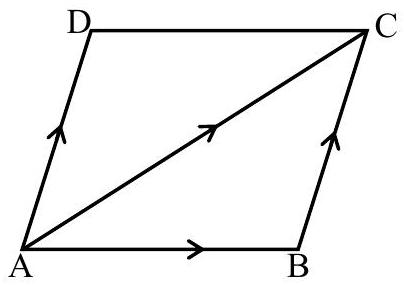
Let $\overrightarrow{\mathrm{AB}}=2 \hat{\mathrm{i}}+4 \hat{\mathrm{j}}-5 \hat{\mathrm{k}}$ and $\overrightarrow{\mathrm{AD}}=\hat{\mathrm{i}}+2 \hat{\mathrm{j}}+\lambda \hat{\mathrm{k}}, \lambda \in \mathrm{R}$. Let the projection of the vector $\overrightarrow{\mathrm{v}}=\hat{\mathrm{i}}+\hat{\mathrm{j}}+\hat{\mathrm{k}}$ on the diagonal $\overrightarrow{\mathrm{AC}}$ of the parallelogram ABCD be of length one unit. If $\alpha, \beta$, where $\alpha>\beta$, be the roots of the equation $\lambda^{2} \mathrm{x}^{2}-6 \lambda \mathrm{x}+5=0$, then $2 \alpha-\beta$ is equal to
[JEE MAIN 22 Jan 2026 S I]
(1) 1
(2) 4
(3) 3
(4) 6
$\overrightarrow{\mathrm{AD}}=\overrightarrow{\mathrm{BC}}$
$\overrightarrow{\mathrm{AC}}=\overrightarrow{\mathrm{AB}}+\overrightarrow{\mathrm{BC}}=\overrightarrow{\mathrm{AB}}+\overrightarrow{\mathrm{AD}}$
$\overrightarrow{\mathrm{AC}}=3 \hat{\mathrm{i}}+6 \hat{\mathrm{j}}+(\lambda-5) \hat{\mathrm{k}}$
Projection of $\vec{V}$ on $\overrightarrow{A C}=\left|\frac{\vec{V} \cdot \overrightarrow{A C}}{|\overrightarrow{A C}|}\right|=1$
$\Rightarrow\left|\frac{3+6+\lambda-5}{\sqrt{9+36+(\lambda-5)^{2}}}\right|=1$
$\Rightarrow|\lambda+4|^{2}=\sqrt{\lambda^{2}-10 \lambda+70} \Rightarrow \lambda^{2}+16+8 \lambda=\lambda^{2}-10 \lambda+70$
$\Rightarrow 18 \lambda=54 \Rightarrow \lambda=3$
Now Quadratic Equation
$9 \mathrm{x}^{2}-18 \mathrm{x}+5=0 \Rightarrow 9 \mathrm{x}^{2}-3 \mathrm{x}-15 \mathrm{x}+5=0$
$\Rightarrow 3 \mathrm{x}(3 \mathrm{x}-1)-5(3 \mathrm{x}-1)=0 \Rightarrow(3 \mathrm{x}-1)(3 \mathrm{x}-5)=0$
$\Rightarrow \mathrm{x}=\frac{1}{3}, \frac{5}{3} \therefore \alpha=\frac{5}{3}, \beta=\frac{1}{3}$
$2 \alpha-\beta=\frac{10}{3}-\frac{1}{3}=\frac{9}{3}=3 \operatorname{Answer}(3)$