- This topic has 1 reply, 1 voice, and was last updated 3 months, 1 week ago by
.
- You must be logged in to reply to this topic.
 shahkb4.
Let $P Q R$ be a triangle such that $\overrightarrow{P Q}=-2 \hat{i}-\hat{j}+2 \hat{k}$ and $\overrightarrow{P R}=a \hat{i}+b \hat{j}-4 \hat{k}, a, b \in Z$.
Let S be the point on QR , which is equidistant from the lines PQ and PR . If $|\overrightarrow{\mathrm{PR}}|=9$ and
$\overrightarrow{\mathrm{PS}}=\left(\frac{\hat{\mathrm{i}}-7 \hat{\mathrm{j}}+2 \mathrm{k}}{4}\right)$, then the value of $3 \mathrm{a}-4 \mathrm{~b}$ is
[JEE MAIN 28 Jan 2026 S I]
[Original question was dropped by NTA, Om Sir has corrected the mistake, Now student can attempt it for practice]
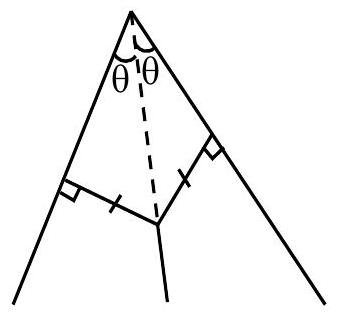
Point S which is equidistant from lines PQ and PR , lies on angle bisector of $\angle \mathrm{QPR}$
$|\overrightarrow{\mathrm{PR}}|=\sqrt{\mathrm{a}^{2}+\mathrm{b}^{2}+16}=9$
$\Rightarrow \mathrm{a}^{2}+\mathrm{b}^{2}+16=81$
$\Rightarrow \mathrm{a}^{2}+\mathrm{b}^{2}=65$
$|\overrightarrow{\mathrm{PQ}}|=\sqrt{4+1+4}=3$
S divides QR in $1: 3$ ratio
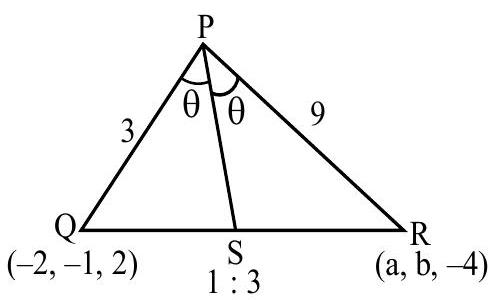
$\mathrm{S}\left(\frac{\mathrm{a}-6}{4}, \frac{\mathrm{~b}-3}{4}, \frac{1}{2}\right)$
$\overrightarrow{\mathrm{PS}}=\frac{(\mathrm{a}-6) \hat{\mathrm{i}}}{4}+\frac{(\mathrm{b}-3) \hat{\mathrm{j}}}{4}+\frac{\hat{\mathrm{k}}}{2}$
$\overrightarrow{\mathrm{PS}}=\frac{\hat{\imath}-7 \hat{\mathrm{j}}+2 \hat{k}}{4}=\frac{(\mathrm{a}-6) \hat{\mathrm{i}}+(\mathrm{b}-3) \hat{\mathrm{j}}+2 \hat{k}}{4}$
We get $a=7, b=-4$
$3 a-4 b=3(7)-4(-4)=21+16=37$ Answer(37)