

Forum Replies Created
-
AuthorPosts
-
shahkb4
KeymasterSolution
\[ \begin{aligned} & \mathrm{n} \in\{1,2,3,4,5,6\} \\ & \Delta=\left|\begin{array}{ccc} 1 & -\mathrm{n} & 1 \\ 1 & \mathrm{n}-2 & \mathrm{n}+1 \\ 0 & \mathrm{n}-1 & 1 \end{array}\right| \\ & \Delta=-(\mathrm{n}-1)(\mathrm{n}-2) \end{aligned} \]For unique solution $\Delta \neq 0 \Rightarrow \mathrm{n} \neq 1, \mathrm{n} \neq 2$
favourable cases $\mathrm{n}=\{3,4,5,6\}$
Required Probability $=\frac{4}{6}=\frac{\mathrm{k}}{6}$\[ \mathrm{k}=4, \mathrm{n}=3,4,5,6 \]required sum $=4+3+4+5+6=22$ Answer(4)
KeymasterSolution
\[ \begin{aligned} & 0,1,2,3,4,5,6,7,8,9 \\ & \mathrm{n}(\mathrm{~S})={ }^{10} \mathrm{C}_{4} \times 1=\frac{10 \cdot 9 \cdot 8 \cdot 7}{24}=210 \\ & \mathrm{xyzwt}=20 \end{aligned} \]Case I: 5,4,1,1,1
Such numbers formed $=\frac{5!}{3!}=\frac{120}{6}=20$
Case II: 5,2,2,1,1
Such numbers formed $=\frac{5!}{2!2!}=\frac{120}{4}=30$\[ \begin{aligned} & n(P)=20+30=50 \\ & n(s)+n(p)=210+50=260 \text { answer }(260) \end{aligned} \]KeymasterSolution
\[ \begin{array}{l|l|l|l} \hline 5 & \mathrm{x} & \mathrm{y} & \mathrm{z} \\ \hline & \mathrm{x}, \mathrm{y}, \mathrm{z} \in\{0,1,2,5,9\} \\ \hline & \frac{5+\mathrm{x}+\mathrm{y}+\mathrm{z}}{3}=1+\frac{\mathrm{x}+\mathrm{y}+\mathrm{z}+2}{3} \in \mathrm{I} \end{array} \][t]{|l|l|l|}
$\mathrm{x}+\mathrm{y}+\mathrm{z}$(x,y,z) ways 1 0,0,1 $3!/ 2!=3$ 4 0,2,2 $3!/ 2!=3$ 4 1,1,2 $3!/ 2!=3$ 7 0,2,5 $3!=6$ 7 1,1,5 $3!/ 2!=3$ 10 0,1,9 $3!=6$ 10 0,5,5 $3!/ 2!=3$ 13 9,2,2 $3!/ 2!=3$ 16 2,5,9 $3!=6$ 19 9,9,1 $3!/ 2!=3$ 19 5,5,9 $3!/ 2!=3$ Total possible ways of $\mathrm{x}, \mathrm{y}, \mathrm{z}=42$ Answer(42)
KeymasterSolution
A, D, P, U,U,Y
A $\_\_\_\_$ such words $=6!/ 2!=360$
D $\_\_\_\_$ such words $=6!/ 2!=360$
P $\_\_\_\_$ such words $=6!/ 2!=360$
R $\_\_\_\_$ such words $=6!/ 2!=360$
Till now 1440 words
U A $\_\_\_\_$ such words $=5!=120$
left →D,P,R,U,Y
Till now 1560 words
UDAP $\_\_\_\_$ such words $=3!=6$
left R,V,Y
U D A R $\_\_\_\_$ such words $=3!=6$
left P,U,Y
U D A U $\_\_\_\_$ such words $=3!=6$
left R,P,Y
Till now 1578 words
UDAYPRU $\rightarrow 1579^{\text {th }}$ word
UDAYPUR $\rightarrow 1580^{\text {th }}$ word Answer(1)KeymasterSolution
Using 5,5,1,2,7,8,6,4 digits
\[ \begin{aligned} & \mathrm{x}=\underset{\substack{\text { Repeating } \\ \text { digit }}}{{ }^{9} \mathrm{C}_{1}} \times \underset{\text { Non repeating }}{{ }^{8} \mathrm{C}_{7}} \times\left(\frac{9!}{2!}\right) \\ & \mathrm{x}=9.8 \frac{9!}{2!}=36(9!) \end{aligned} \]Using 1,1,7,7,4,2,5,6,9 digits
\[ \mathrm{y}=\underset{\substack{\text { repeating } \\ \text { digits }}}{{ }^{9} \mathrm{C}_{2}} \times{ }_{\substack{\text { Non-repeating } \\ \text { digits }}}^{{ }^{7} \mathrm{C}_{5}} \times \frac{9!}{2!2!} \]\[ \begin{aligned} & y=\left(\frac{9.8}{2}\right)\left(\frac{7.6}{2}\right)\left(\frac{9!}{2!2!}\right)=9(7) 3.9! \\ & \frac{x}{y}=\frac{36(9!)}{9(7)(3) 9!} \Rightarrow \frac{x}{y}=\frac{4}{21} \Rightarrow 21 x=4 y \text { Answer }(3) \end{aligned} \]KeymasterSolution
\[ \begin{aligned} & \text { available floors } \rightarrow 4^{\text {th }}, 5^{\text {th }}, \ldots 9^{\text {th }}, 10^{\text {th }} \\ & \text { Required ways }=\left({ }^{7} \mathrm{C}_{3}\right) 3!=\frac{765}{6} \times 6=7(30)=210 \text { Answer }(210) \end{aligned} \]KeymasterSolution
\[ \begin{aligned} & 6^{m}+9^{n}=(5+1)^{m}+(10-1)^{n} \\ & =\left({ }^{m} C_{0} 5^{m}+\ldots+{ }^{m} C_{m-1} 5+{ }^{m} C_{m}\right)+\left({ }^{n} C_{0} 10^{n}-{ }^{n} C_{1} 10^{n-1}+\ldots+{ }^{n} C_{n-1} 10+{ }^{n} C_{n}(-1)^{n}\right] \\ & =(5 k+1)+\left(10 \lambda+(-1)^{n}\right) \\ & =5(k+2 \lambda)+1+(-1)^{n} \\ & m \in\{1,2,3,4, \ldots, 49,50\} \end{aligned} \]n must be an odd no i.e. $\mathrm{n} \in\{1,3,5,7, \ldots, 49\}$;
\[ \begin{aligned} & \mathrm{p}=50 \times 25=1250 \\ & \mathrm{~m}+\mathrm{n}=2^{2}=4 \\ & (\mathrm{~m}, \mathrm{n})=(1,3),(2,2),(3,1) \rightarrow 3 \\ & \mathrm{~m}+\mathrm{n}=3^{2}=9 \\ & (\mathrm{~m}, \mathrm{n})=(1,8),(2,7)(3,6), \ldots(8,1) \rightarrow 8 \\ & \mathrm{~m}+\mathrm{n}=5^{2}=25 \\ & (\mathrm{~m}, \mathrm{n})=(1,24)(2,23),(3,21) \ldots(24,1) \rightarrow 24 \\ & \mathrm{~m}+\mathrm{n}=7^{2}=49 \\ & (\mathrm{~m}, \mathrm{~m})=(1,48)(2,47),(3,46), \ldots(48,1) \rightarrow 48 \\ & (\mathrm{~m}+\mathrm{n})_{\max }=100 \\ & \mathrm{~m}+\mathrm{n} \neq 11^{2}=121 \end{aligned} \]\[ \begin{aligned} & q=3+8+24+48=83 \\ & \therefore p+q=1250+83=1333 \text { Answer }(1333) \end{aligned} \]KeymasterSolution
[t]{|l|l|l|}
ABBC CA 2 2 $1 \rightarrow{ }^{4} \mathrm{C}_{2}{ }^{5} \mathrm{C}_{2}{ }^{4} \mathrm{C}_{1}=6 \times 10 \times 4=240$ 2 1 $2 \rightarrow{ }^{4} \mathrm{C}_{2}{ }^{5} \mathrm{C}_{1}{ }^{4} \mathrm{C}_{2}=6(5) 6=180$ 1 2 $2 \rightarrow{ }^{4} \mathrm{C}_{1}{ }^{5} \mathrm{C}_{2}{ }^{4} \mathrm{C}_{2}=4(10) 6=240$ 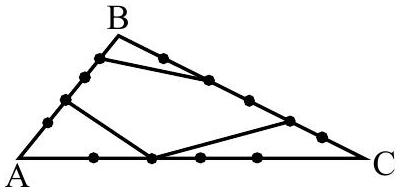
Required no. of pentagons = 660 Answer(660)KeymasterSolution
First Method:
\[ \mathrm{S}=\{1,2,3,4, \ldots, 10,11\} \]even no →2,4,6,8,10
odd no →1,3,5,7,9,11
Total subsets $=2^{11}$
No of subsets such that product of numbers is $\mathrm{odd}=2^{6}$
No of subsets such that product of number is even $=2^{11}-2^{6}=2048-64=1984$ required no of subsets $=1984-(\mathrm{n}(\mathrm{B})=1$ \& Product is even $)$\[ =1984-5=1979 \text { Ans. } \]Second Method:
\[ \begin{array}{ll} \mathrm{n}(\mathrm{~B})=2, & \quad{ }^{11} \mathrm{C}_{2}-{ }^{6} \mathrm{C}_{2} \text { (all are odds) } \\ \mathrm{n}(\mathrm{~B})=3, & { }^{11} \mathrm{C}_{3}-{ }^{6} \mathrm{C}_{3} \text { (all are odds) } \\ \mathrm{n}(\mathrm{~B})=4, & { }^{11} \mathrm{C}_{4}-{ }^{6} \mathrm{C}_{4} \text { (all are odds) } \\ \mathrm{n}(\mathrm{~B})=5, & { }^{11} \mathrm{C}_{5}-{ }^{6} \mathrm{C}_{5} \text { (all are odds) } \\ \mathrm{n}(\mathrm{~B})=6, & { }^{11} \mathrm{C}_{6}-{ }^{6} \mathrm{C}_{6} \text { (all are odds) } \\ \mathrm{n}(\mathrm{~B})=7, & { }^{11} \mathrm{C}_{7}-0 \\ \mathrm{n}(\mathrm{~B})=8 & { }^{11} \mathrm{C}_{8} \\ \mathrm{n}(\mathrm{~B})=9, & { }^{11} \mathrm{C}_{9} \\ \mathrm{n}(\mathrm{~B})=10, & { }^{11} \mathrm{C}_{10} \\ \mathrm{n}(\mathrm{~B})=11, & { }^{11} \mathrm{C}_{11} \end{array} \]required no. of subsets $=\sum_{\mathrm{r}=2}^{11}{ }^{11} \mathrm{C}_{\mathrm{r}}-\sum_{\mathrm{r}=2}^{6}{ }^{6} \mathrm{C}_{\mathrm{r}}$
\[ \begin{aligned} & =\left(2^{11}-{ }^{11} \mathrm{C}_{0}-{ }^{11} \mathrm{C}_{1}\right)-\left(2^{6}-{ }^{6} \mathrm{C}_{0}-{ }^{6} \mathrm{C}_{1}\right) \\ & =2048-1-11-(64-1-6) \\ & =2048-64-5=1979 \text { Answer }(1979) \end{aligned} \]KeymasterSolution
\begin{itemize}
\item[] (P,P,P) (QQ) (RR) S,T,U,V
\item[(i)] 3 same, 1 diff. $(\mathrm{P}, \mathrm{P}, \mathrm{P}, \mathrm{R}) \rightarrow 1 \times{ }^{6} \mathrm{C}_{1} \times\left(\frac{4!}{3!}\right)=6 \times 4=24$
\item[(ii)] 2 same, 2 diff. (Q,Q,P,T) → ${ }^{3} \mathrm{C}_{1} \times{ }^{6} \mathrm{C}_{2} \times\left(\frac{4!}{2!}\right)=3 \times 15 \times 12=450+90=540$
\item[(iii)] 2 same, 2 same $(\mathrm{P}, \mathrm{P}, \mathrm{R}, \mathrm{R}) \rightarrow{ }^{3} \mathrm{C}_{2} \times\left(\frac{4!}{2!2!}\right)=\frac{3 \times 24}{4}=18$
\item[(iv)] 4 different $(\mathrm{P}, \mathrm{R}, \mathrm{U}, \mathrm{V}) \rightarrow{ }^{7} \mathrm{C}_{4}(4!)=\frac{7.6 .5}{6} \times 24=42(20)=840$
\end{itemize}Total such words $=24+540+18+840=1422$ Answer(1422)
KeymasterSolution
assuming all oranges are identical
Let children $\mathrm{C}_{1}, \mathrm{C}_{2}, \mathrm{C}_{3}, \mathrm{C}_{4}$ get number of oranges $\mathrm{x}_{1}, \mathrm{x}_{2}, \mathrm{x}_{3}, \mathrm{x}_{4}$\[ \begin{aligned} & \mathrm{x}_{1}+\mathrm{x}_{2}+\mathrm{x}_{3}+\mathrm{x}_{4}=16 \text { where } \mathrm{x}_{1}, \mathrm{x}_{2}, \mathrm{x}_{3}, \mathrm{x}_{4} \geq 1 \\ & \text { let } \mathrm{x}_{\mathrm{i}}=\mathrm{x}_{\mathrm{i}}^{\prime}+1 ; \mathrm{x}_{1}^{\prime}+\mathrm{x}_{2}^{\prime}+\mathrm{x}_{3}^{\prime}+\mathrm{x}_{4}^{\prime}=12 \end{aligned} \]Number of non-negative integral solutions ${ }^{\mathrm{n}+\mathrm{p}-1} \mathrm{C}_{\mathrm{p}-1}={ }^{12+4-1} \mathrm{C}_{4-1}$
\[ ={ }^{15} \mathrm{C}_{3}=455 \text { Answer }(4) \]KeymasterSolution
line $\mathrm{L}_{1}: \frac{\mathrm{x}-4}{2}=\frac{\mathrm{y}-0}{0}=\frac{\mathrm{z}+1}{3}=\lambda$
line $\mathrm{L}_{2}: \frac{\mathrm{x}-43}{3}=\frac{\mathrm{y}-\alpha}{-1}=\frac{\mathrm{z}-\beta}{0}=\mu$
$\mathrm{Q}(2 \lambda+4,0,3 \lambda-1) \equiv \mathrm{Q}(3 \mu+43,-\mu+\alpha, \beta)$\[ 2 \lambda+4=3 \mu+43 \Rightarrow 2 \lambda=3 \mu+39 \]\[ 0=-\mu+\alpha=\alpha=\mu \] \[ 3 \lambda-1=\beta \]\[ \mathrm{Q}(3 \alpha+43,0, \beta) \mathrm{P}(43, \alpha, \beta) \]\[ \begin{aligned} & P Q=13 \sqrt{10} \Rightarrow \sqrt{9 \alpha^{2}+\alpha^{2}+0}=13 \sqrt{10} \\ & \Rightarrow|\alpha| \sqrt{10}=13 \sqrt{10} \Rightarrow \alpha= \pm 13 \end{aligned} \]
Case I: $\alpha=13, \mu=13$, given $\beta<0$
From (1), $2 \lambda=3 \mu+39=78 \Rightarrow \lambda=39$
From (2), $\beta=3 \lambda-1=3 \times 39-1>0$ (rejected)
Case II : $\alpha=-13, \mu=-13$
From (1), $2 \lambda=-39+39 \Rightarrow \lambda=0$
From (3), $\beta=3 \lambda-1=-1$
Now $\alpha^{2}+\beta^{2}=169+1=170$ Answer(170)KeymasterSolution
line $\frac{\mathrm{x}-1}{1}=\frac{\mathrm{y}}{2}=\frac{\mathrm{z}-1}{1}=\lambda$
$\mathrm{M}(\lambda+1,2 \lambda, \lambda+1)$
$\mathrm{PM} \xrightarrow{\mathrm{drs}} \lambda-2,2 \lambda-2, \lambda$
line $\xrightarrow{\mathrm{drs}} 1,2,1$
$\mathrm{PM} \perp$ line $\Rightarrow \lambda-2+4 \lambda-4+\lambda=0$
$\Rightarrow 6 \lambda=6 \Rightarrow \lambda=1$
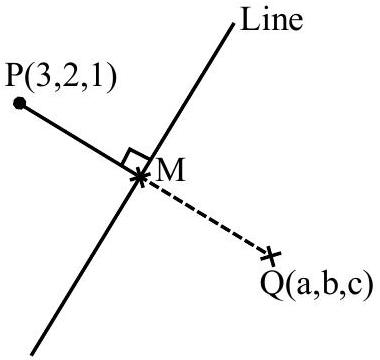
we get $\mathrm{M}(2,2,2)$ and $\mathrm{Q}(1,2,3)$
Now distance of Q from another line\[ \begin{aligned} & \frac{x-9}{3}=\frac{y-9}{2}=\frac{z-5}{-2}=t \\ & R(3 t+9,2 t+9,-2 t+5) \\ & Q R \xrightarrow{d r s} 3 t+8,2 t+7,-2 t+2 \end{aligned} \]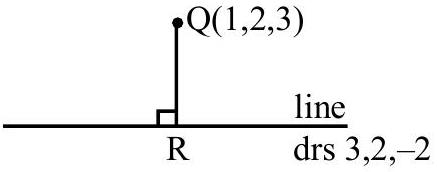
line $\xrightarrow{\mathrm{drs}} 3,2,-2$
QR ⟂ line\[ \begin{aligned} & (3 \mathrm{t}+8) 3+2(2 \mathrm{t}+7)-2(-2 \mathrm{t}+2)=0 \\ & \Rightarrow 17 \mathrm{t}+24+14-4=0 \\ & \Rightarrow \mathrm{t}=-2, \mathrm{R}(3,5,9) \\ & \mathrm{QR} \equiv \sqrt{4+9+36}=7 \end{aligned} \]Second Method:
\[ \begin{aligned} & \overrightarrow{\mathrm{AQ}}=-8 \hat{i}-7 \hat{j}-2 \hat{k} \\ & \overrightarrow{\mathrm{AR}} \|(3 \hat{i}+2 \hat{j}-2 \hat{k}) \end{aligned} \]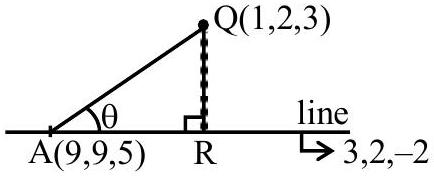 \[ \begin{aligned} & |\overrightarrow{\mathrm{QR}}|=|\overrightarrow{\mathrm{AQ}}| \sin \theta=\frac{|\overrightarrow{\mathrm{AQ}} \times \overrightarrow{\mathrm{AR}}|}{|\overrightarrow{\mathrm{AR}}|}=\mid \overrightarrow{\mathrm{AQ}} \times \mathrm{AR} \\ & =\left|\begin{array}{ccc} \hat{\mathrm{i}} & \hat{\mathrm{j}} & \hat{\mathrm{k}} \\ -8 & -7 & -2 \\ \frac{3}{\sqrt{17}} & \frac{2}{\sqrt{17}} & -\frac{2}{\sqrt{17}} \end{array}\right|=\frac{1}{\sqrt{17}}|18 \hat{\mathrm{i}}-22 \hat{\mathrm{j}}+5 \hat{\mathrm{k}}| \\ & =\sqrt{\frac{324+484+25}{17}}=\sqrt{\frac{833}{17}}=\sqrt{49}=7 \end{aligned} \]
Third Method
\[ \begin{aligned} & \overrightarrow{\mathrm{AQ}}=-8 \hat{\mathrm{i}}-7 \hat{\mathrm{j}}-2 \hat{\mathrm{k}} ; \mathrm{AQ}=\sqrt{64+49+4}=\sqrt{117} \\ & \mathrm{AR}=\text { Projection of } \overrightarrow{\mathrm{AQ}} \text { on given line whose drs } 3,2,-2 \\ & =\left|\frac{-8(3)-7(2)-2(-2)}{\sqrt{9+4+4}}\right|=\frac{|-24-14+4|}{\sqrt{17}}=2 \sqrt{17} \\ & \mathrm{QR}=\sqrt{\mathrm{AQ}^{2}-\mathrm{AR}^{2}}=\sqrt{117-4 \times 17}=\sqrt{49}=7 \text { Answer }(3) \end{aligned} \]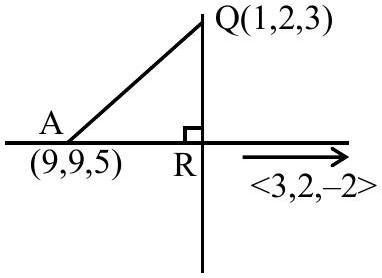 Keymaster
Solution
First line $\mathrm{L}_{1}$ passes through point $\mathrm{A}(-1,2,4)$ with drs $\alpha,-1,-\alpha$
First line $\mathrm{L}_{1}$ passes through point $\mathrm{B}(0,1,1)$ with drs $\alpha, 2,2 \alpha$
shortest distance $\mathrm{b} / \mathrm{w}$ skew lines $=\frac{\left|\begin{array}{ccc}\mathrm{x}_{2}-\mathrm{x}_{1} & \mathrm{y}_{2}-\mathrm{y}_{1} & \mathrm{z}_{2}-\mathrm{z}_{1} \\ \mathrm{a}_{1} & \mathrm{~b}_{1} & \mathrm{c}_{1} \\ \mathrm{a}_{2} & \mathrm{~b}_{2} & \mathrm{c}_{2}\end{array}\right|}{\left\|\begin{array}{ccc}\hat{\mathrm{i}} & \hat{\mathrm{j}} & \hat{\mathrm{k}} \\ \mathrm{a}_{1} & \mathrm{~b}_{1} & \mathrm{c}_{1} \\ \mathrm{a}_{2} & \mathrm{~b}_{2} & \mathrm{c}_{2}\end{array}\right\|}$\[ =\frac{\left|\begin{array}{ccc} 1 & -1 & -3 \\ \alpha & -1 & -\alpha \\ \alpha & 2 & 2 \alpha \end{array}\right|}{\left|\begin{array}{ccc} \hat{\mathrm{i}} & \hat{\mathrm{j}} & \hat{\mathrm{k}} \\ \alpha & -1 & -\alpha \\ \alpha & 2 & 2 \alpha \end{array}\right|}=\sqrt{2} \]\[ \begin{aligned} & \Rightarrow \frac{\left|(-2 \alpha+2 \alpha)+1\left(2 \alpha^{2}+\alpha^{2}\right)-3(3 \alpha)\right|}{\left|0-3 \alpha^{2} \hat{j}+3 \alpha \hat{k}\right|}=\sqrt{2} \\ & \Rightarrow \frac{\left|3 \alpha^{2}-9 \alpha\right|}{\sqrt{9 \alpha^{4}+9 \alpha^{2} \mid}}=\sqrt{2} \Rightarrow \frac{3|\alpha-3 \| \alpha|}{3 \alpha \sqrt{\alpha^{2}+1}}=\sqrt{2} \\ & \Rightarrow|\alpha-3|=\sqrt{2} \sqrt{\alpha^{2}+1} \Rightarrow \alpha^{2}+9-6 \alpha=2 \alpha^{2}+2 \\ & \Rightarrow \alpha^{2}+6 \alpha-7=0 \Rightarrow(\alpha+7)(\alpha-1)=0 \\ & \alpha=-7,1 \text { sum of } \alpha=-6 \text { Answer(2) } \end{aligned} \]KeymasterSolution
Point $\mathrm{B}(3 \lambda+1,4 \lambda+2, \mathrm{~b} \lambda+\mathrm{a})$ on line $\mathrm{L}_{1}$ It also lies on given line L
\[ \begin{aligned} & \frac{3 \lambda+1-1}{1}=\frac{4 \lambda+2}{2}=\frac{b \lambda+a-1}{1} \\ & \Rightarrow 3 \lambda=2 \lambda+1=b \lambda+a-1 \\ & \Rightarrow \lambda=1,3=b+a-1 \Rightarrow a+b=4 \\ & B(4,6, a+b) \equiv B(4,6,4) \end{aligned} \]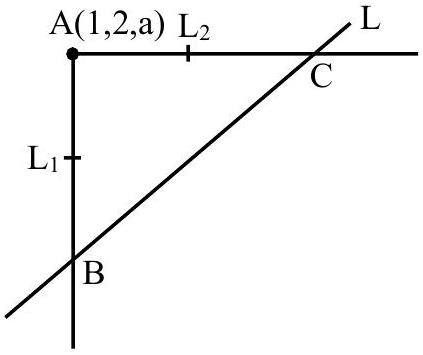
similarly Point C lies on $\mathrm{L}_{2}$\[ c(\mu+1,4 \mu+2, c \mu+a) \]It lies on line L also
\[ \begin{aligned} & \frac{\mu+1-1}{1}=\frac{4 \mu+2}{2}=\frac{c \mu+a-1}{1} \\ & \Rightarrow \mu=2 \mu+1=c \mu+a-1 \\ & \Rightarrow \mu=-1 \text { and } a=c \\ & C(0,-2, a-c) \equiv C(0,-2,0) \\ & \because A B=A C \Rightarrow A B^{2}=A C^{2} \\ & \Rightarrow 3^{2}+4^{2}+(a-4)^{2}=1^{2}+4^{2}+a^{2} \\ & \Rightarrow 8+a^{2}-8 a+16=a^{2} \\ & \Rightarrow 89=24 \Rightarrow a=3=c, b=1 \\ & \therefore a+b+c=7 \text { Answer }(1) \end{aligned} \] -
AuthorPosts