
shahkb4

Forum Replies Created
-
AuthorPosts
-
Solution
Expectation $\mathrm{E}(\mathrm{x})=\sum \mathrm{x}_{\mathrm{i}} \mathrm{P}\left(\mathrm{x}_{\mathrm{i}}\right)=\frac{263}{15}$
$\Rightarrow \frac{28 \times 2 \mathrm{k}+30 \mathrm{k}+64 \mathrm{k}+102 \mathrm{k}+36 \mathrm{k}+76 \mathrm{k}+120 \mathrm{k}+42 \mathrm{k}}{7 \times 15}=\frac{263}{15}$
$\Rightarrow 526 \mathrm{k}=263 \times 7 \Rightarrow \mathrm{k}=\frac{7}{2}$X 14 15 16 17 18 19 20 21 $\mathrm{P}(\mathrm{x})$ $\frac{2}{15}$ $\frac{1}{15}$ $\frac{2}{15}$ $\frac{3}{15}$ $\frac{1}{15}$ $\frac{2}{15}$ $\frac{3}{15}$ $\frac{1}{15}$ $\mathrm{P}(\mathrm{x}<20)=\frac{2+1+2+3+1+2}{15}=\frac{11}{15}$ Answer(3)
Solution
A bag contains 10 balls out of which k are red and ( $10-\mathrm{k}$ ) are black
There are 8 possibilities as
$\mathrm{K}=0\left(\mathrm{E}_{0}\right) 0$ Red 10 Black
$\mathrm{K}=1\left(\mathrm{E}_{1}\right) \quad 1$ Red 9 Black
$\mathrm{K}=2\left(\mathrm{E}_{2}\right) 2$ Red 8 Black
$\mathrm{K}=3\left(\mathrm{E}_{3}\right) 3$ Red 7 Black
$\mathrm{K}=7\left(\mathrm{E}_{7}\right) 7$ Red 3 Black
$\mathrm{P}\left(\mathrm{E}_{1}\right)=\mathrm{P}\left(\mathrm{E}_{2}\right)=\mathrm{P}\left(\mathrm{E}_{3}\right)=\ldots=\mathrm{P}\left(\mathrm{E}_{7}\right)=\mathrm{p}$
$\mathrm{P}\binom{\text { all 3 }}{\text { are black }}=\mathrm{p} \frac{{ }^{10} \mathrm{C}_{3}}{{ }^{10} \mathrm{C}_{3}}+\mathrm{p} \frac{{ }^{9} \mathrm{C}_{3}}{{ }^{10} \mathrm{C}_{3}}+\mathrm{p} \frac{{ }^{8} \mathrm{C}_{3}}{{ }^{10} \mathrm{C}_{3}}+\cdots+\mathrm{p} \frac{{ }^{3} \mathrm{C}_{3}}{{ }^{10} \mathrm{C}_{3}}$
$\mathrm{P}\left(\mathrm{E}_{1} /\right.$ All3Blacks $)=\frac{{ }^{9} \mathrm{C}_{3}}{{ }^{10} \mathrm{C}_{3}+{ }^{9} \mathrm{C}_{3}+{ }^{8} \mathrm{C}_{3}+\ldots .+{ }^{3} \mathrm{C}_{3}}$
$\left(\because{ }^{\mathrm{n}} \mathrm{C}_{\mathrm{r}}+{ }^{\mathrm{n}} \mathrm{C}_{\mathrm{r}+1}={ }^{\mathrm{n}+1} \mathrm{C}_{\mathrm{r}+1}\right)$
${ }^{3} \mathrm{C}_{3}+{ }^{4} \mathrm{C}_{3}+{ }^{5} \mathrm{C}_{3}+\cdots+{ }^{8} \mathrm{C}_{3}+{ }^{9} \mathrm{C}_{3}+{ }^{10} \mathrm{C}_{3}$
$={ }^{4} \mathrm{C}_{4}+{ }^{4} \mathrm{C}_{3}+{ }^{5} \mathrm{C}_{3}+\ldots .+{ }^{9} \mathrm{C}_{3}+{ }^{10} \mathrm{C}_{3}$
$={ }^{5} \mathrm{C}_{4}+{ }^{5} \mathrm{C}_{3}+\ldots .+{ }^{9} \mathrm{C}_{3}+{ }^{10} \mathrm{C}_{3}$
$={ }^{6} \mathrm{C}_{4}+\ldots .+{ }^{9} \mathrm{C}_{3}+{ }^{10} \mathrm{C}_{3}$
$={ }^{10} \mathrm{C}_{4}+{ }^{10} \mathrm{C}_{3}={ }^{11} \mathrm{C}_{4}$
Pr ob. $=\frac{{ }^{9} \mathrm{C}_{3}}{{ }^{11} \mathrm{C}_{4}}=\frac{9.8 .7}{6\left(\frac{11.10 .9 .8}{24}\right)}=\frac{14}{55}$ Answer(4)Solution
(10 Defective, 90 Non-defective)
Required Probability of getting atleast 7 defective bulbs out 8 bulbs $=\mathrm{P}($ Exactly 7 defective bulbs $)+\mathrm{P}($ all 8 defective bulbs $)$
$={ }^{8} \mathrm{C}_{7}\left(\frac{10}{100}\right)^{7}\left(\frac{90}{100}\right)+\left(\frac{10}{100}\right)^{8}=8\left(\frac{1}{10}\right)^{7}\left(\frac{9}{16}\right)+\left(\frac{1}{100}\right)^{8}=\frac{72+1}{108}=\frac{73}{10^{8}}$ Answer(4)Solution
Event $\mathrm{E}_{1}$ : white ball is transferred
Event $\mathrm{E}_{2}$ : Black ball is transferred\[ \mathrm{P}\left(\mathrm{E}_{1}\right)=\frac{6}{6+4}=\frac{3}{5}, \mathrm{P}\left(\mathrm{E}_{2}\right)=\frac{4}{6+4}=\frac{2}{5} \]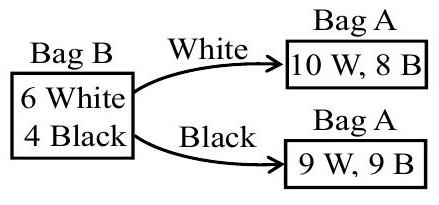
Event X : From bag A , white ball is drawn
\[ \begin{aligned} & \mathrm{P}(\mathrm{X})=\mathrm{P}\left(\mathrm{E}_{1}\right) \mathrm{P}\left(\frac{\mathrm{X}}{\mathrm{E}_{1}}\right)+\mathrm{P}\left(\mathrm{E}_{2}\right) \mathrm{P}\left(\frac{\mathrm{X}}{\mathrm{E}_{2}}\right) \\ & =\frac{3}{5}\left(\frac{10}{18}\right)+\frac{2}{5}\left(\frac{9}{18}\right)=\frac{30+18}{5 \times 18}=\frac{8}{15}=\frac{\mathrm{p}}{\mathrm{q}} \\ & \therefore \mathrm{p}+\mathrm{q}=23 \text { Answer }(2) \end{aligned} \]Solution
$\mathrm{a}, \mathrm{b} \in\{1,2,3, \ldots, 99,100\}$
Total cases $=100 \times 99$
Favourable cases $a-b \geq 10$
No of Pairs of (a,b)\[ \begin{array}{ll} b=1, a \geq 11 & a \rightarrow 11,12,13, \ldots, 99,100 \\ b=2, a \geq 12 & a \rightarrow 12,13,14, \ldots, 99,100 \end{array} \]$b=3, a \geq 13$ $a \rightarrow 13,14,15, \ldots, 99,100$ 88 $\vdots$ $b=88, a \geq 98$ $a \rightarrow 98,99,100$ 3 $b=89, a \geq 99$ $a \rightarrow 99,100$ 2 $b=90, a \geq 100$ $a \rightarrow 100$ 1 No. of favourable ordered pair $=1+2+3+\ldots .+89+90$
\[ =\frac{90(90+1)}{2}=45 \times 91 \]Required probability $=\frac{45 \times 91}{100 \times 99}=\frac{91}{220}=\frac{\mathrm{m}}{\mathrm{n}}$
\[ \mathrm{m}+\mathrm{n}=91+220=311 \text { Answer }(311) \]Solution
$\mathrm{n} \in\{1,2,3,4,5,6\}$
$\Delta=\left|\begin{array}{ccc}1 & -n & 1 \\ 1 & n-2 & n+1 \\ 0 & n-1 & 1\end{array}\right|$
$\Delta=-(\mathrm{n}-1)(\mathrm{n}-2)$
For unique solution $\Delta \neq 0 \Rightarrow n \neq 1, n \neq 2$
favourable cases $n=\{3,4,5,6\}$
Required Probability $=\frac{4}{6}=\frac{\mathrm{k}}{6}$
$\mathrm{k}=4, \mathrm{n}=3,4,5,6$
required sum $=4+3+4+5+6=22$ Answer(4)Solution
$\sum \mathrm{P}\left(\mathrm{x}_{\mathrm{i}}\right)=0+2 \mathrm{k}+\mathrm{k}+3 \mathrm{k}+2 \mathrm{k}^{2}+2 \mathrm{k}+\mathrm{k}^{2}+\mathrm{k}+7 \mathrm{k}^{2}=1$
$\Rightarrow 10 \mathrm{k}^{2}+9 \mathrm{k}-1=0 \Rightarrow(10 \mathrm{k}-1)(\mathrm{k}+1)=0 \Rightarrow \mathrm{k}=\frac{1}{10}, \mathrm{k} \neq-1$
$\mathrm{P}(3<\mathrm{x} \leq 6)=\mathrm{P}(\mathrm{x}=4)+\mathrm{P}(\mathrm{x}=5)+\mathrm{P}(\mathrm{x}=6)$ $=2 \mathrm{k}^{2}+2 \mathrm{k}+\mathrm{k}^{2}+\mathrm{k}=3 \mathrm{k}^{2}+3 \mathrm{k}=\frac{3}{100}+\frac{3}{10}=0.33$ Answer(4)Solution
First Method:
$\mathrm{P}(\mathrm{ab}$ is divisible by 3$)$
$=\mathrm{P}(\mathrm{a} \& \mathrm{~b}$ both are multiple of 3$)+\mathrm{P}($ Exactly are of $\mathrm{a} \& \mathrm{~b}$ is multiple of 3$)$
$=\frac{{ }^{16} \mathrm{C}_{2}}{{ }^{50} \mathrm{C}_{2}}+\frac{{ }^{16} \mathrm{C}_{1} \times{ }^{34} \mathrm{C}_{1}}{{ }^{50} \mathrm{C}_{2}}=\frac{8.15+16.34}{25(49)}=\frac{664}{1225}$
$3 \mathrm{~K}=\{3,6,9, \ldots, 48\}$Second Method:
Number which are not multiple of $3=50-16=34$
$\mathrm{P}(\mathrm{ab}$ is divisible by 3$)=1-\mathrm{P}(\mathrm{ab}$ is not divisible by 3$)$
$=1-\frac{{ }^{34} \mathrm{C}_{2}}{{ }^{50} \mathrm{C}_{2}}=1-\frac{17 \times 93}{25 \times 49}=\frac{1225-561}{1225}=\frac{664}{1225}$ Answer(2)Solution
\[ 40=8 \times 5=2^{3} \times 5 \]Exponent of 2 in $60!=\left[\frac{60}{2}\right]+\left[\frac{60}{4}\right]+\left[\frac{60}{8}\right]+\left[\frac{60}{16}\right]+\left[\frac{60}{32}\right]+\left[\frac{60}{64}\right]+\cdots$
\[ =30+15+7+3+1+0+\cdots=56 \]Exponent of 5 in $60!=\left[\frac{60}{5}\right]+\left[\frac{60}{25}\right]+\left[\frac{60}{125}\right]+\cdots=12+2+0=14$
\[ 60!=2^{56} 5^{14}(\mathrm{~K})=2^{14}\left(2^{42}\right) 5^{14} \mathrm{~K}=2^{14}\left(2^{3} \times 5\right)^{14} \mathrm{~K}=2^{14}(40)^{14} \mathrm{~K} \]∴ Maximum value of n is 14
Answer (4)Solution
Using 5,5,1,2,7,8,6,4 digits
\[ \mathrm{x}=\underset{\substack{\text { Repeating } \\ \text { digit }}}{{ }^{9} \mathrm{C}_{1}} \times \underset{\substack{\text { Non repeating } \\ \text { digits }}}{{ }^{8} \mathrm{C}_{7}} \times \underset{\text { arrangement }}{\left(\frac{9!}{2!}\right)} \]$x=9.8 \frac{9!}{2!}=36(9!)$
Using 1,1,7,7,4,2,5,6,9 digits
$\mathrm{y}=\underset{\substack{\text { repeating } \\ \text { digits }}}{{ }^{9} \mathrm{C}_{2}} \times \underset{\substack{\text { Non-repeating } \\ \text { digits }}}{{ }^{7} \mathrm{C}_{5}} \times \frac{9!}{2!2!}$
$y=\left(\frac{9.8}{2}\right)\left(\frac{7.6}{2}\right)\left(\frac{9!}{2!2!}\right)=9(7) 3.9!$
$\frac{x}{y}=\frac{36(9!)}{9(7)(3) 9!} \Rightarrow \frac{x}{y}=\frac{4}{21} \Rightarrow 21 x=4 y$ Answer(3)Solution
A, D, P, U,U,Y
A □ such words $=6!/ 2!=360$
D $\_\_\_\_$ such words $=6!/ 2!=360$
$\mathrm{P}—-$ such words $=6!/ 2!=360$
R $\_\_\_\_$ such words $=6!/ 2!=360$
Till $\overline{\mathrm{n}} \overline{\mathrm{ow}} \overline{1} 4 \overline{4} 0$ wordsU
U A □ such words $=5!=120$
left → D, P, R, U, Y
Till now 1560 words
U D A P $\_\_\_\_$ such words $=3!=6$
left R,V,Y
U D A R $\_\_\_\_$ such words $=3!=6$
left P,U,Y
U D A U $\_\_\_\_$ such words $=3!=6$
left R,P,Y
Till now 1578 words
UDAYPRU $\rightarrow 1579{ }^{\text {th }}$ word
UDA Y P U R $\rightarrow 1580{ }^{\text {th }}$ word Answer(1)Solution
5 x y z $\quad \mathrm{x}, \mathrm{y}, \mathrm{z} \in\{0,1,2,5,9\}$
\[ \frac{5+x+y+z}{3}=1+\frac{x+y+z+2}{3} \in I \]$\mathrm{x}+\mathrm{y}+\mathrm{z}$ $(\mathrm{x}, \mathrm{y}, \mathrm{z})$ ways 1 $0,0,1$ $3!/ 2!=3$ 4 $0,2,2$ $3!/ 2!=3$ 4 $1,1,2$ $3!/ 2!=3$ 7 $0,2,5$ $3!=6$ 7 $1,1,5$ $3!/ 2!=3$ 10 $0,1,9$ $3!=6$ 10 $0,5,5$ $3!/ 2!=3$ 13 $9,2,2$ $3!/ 2!=3$ 16 $2,5,9$ $3!=6$ 19 $9,9,1$ $3!/ 2!=3$ 19 $5,5,9$ $3!/ 2!=3$ Total possible ways of $\mathrm{x}, \mathrm{y}, \mathrm{z}=42$ Answer(42)
Solution
0,1,2,3,4,5,6,7,8,9
$\mathrm{n}(\mathrm{S})={ }^{10} \mathrm{C}_{4} \times 1=\frac{10 \cdot 9 \cdot 8 \cdot 7}{24}=210$
xyzwt $=20$
Case I: 5, 4, 1, 1, 1
Such numbers formed $=\frac{5!}{3!}=\frac{120}{6}=20$
Case II: 5, 2, 2, 1, 1
Such numbers formed $=\frac{5!}{2!2!}=\frac{120}{4}=30$
$\mathrm{n}(\mathrm{P})=20+30=50$
$\mathrm{n}(\mathrm{s})+\mathrm{n}(\mathrm{p})=210+50=260$ answer(260) -
AuthorPosts
