

Forum Replies Created
-
AuthorPosts
-
UPLIFTJEE
KeymasterAnswer
D
30 October, 2026 at 8:11 am in reply to: Let $\left|\frac{\bar{z}-\mathrm{i}}{2 \bar{z}+\mathrm{i}}\right|=\frac{1}{3}, \mathrm{z} \in \mathrm{C}$, be the equation of a circle with center at C. If the area of the triangle, whose vertices are at the points (0, 0), C and $(\alpha, 0)$ is 11 square units, then $\alpha^{2}$ equals #12491KeymasterSolution
$\left|\frac{\bar{z}-\mathrm{i}}{2 \bar{z}+\mathrm{i}}\right|=\frac{1}{3} \Rightarrow\left|\frac{\bar{z}-\mathrm{i}}{\bar{z}+\frac{\mathrm{i}}{2}}\right|=\frac{2}{3} \Rightarrow 3|\mathrm{x}-\mathrm{iy}-\mathrm{i}|=2\left|\mathrm{x}-\mathrm{iy}+\frac{\mathrm{i}}{2}\right|$
\[ \Rightarrow 9\left(x^{2}+(y+1)^{2}\right)=4\left(x^{2}+(y-1 / 2)^{2}\right) \Rightarrow 9 x^{2}+9 y^{2}+18 y+9=4 x^{2}+4 y^{2}-4 y+1 \Rightarrow 5 x^{2}+5 y^{2}+22 y+8=0 \]\[ \begin{aligned} & \Rightarrow \mathrm{x}^{2}+\mathrm{y}^{2}+\frac{22}{5} \mathrm{y}+\frac{8}{5}=0 \text { centre } \mathrm{C}\left(0,-\frac{11}{5}\right) \text { Area of triangle formed by }(0,0),\left(0,-\frac{11}{5}\right) \text { and }(\alpha, 0) \text { is }\left|\frac{1}{2}\right| \begin{array}{ccc} 0 & 0 & 1 \\ 0 & -11 / 5 & 1 \\ \alpha & 0 & 1 \end{array}|\mid=11 \\ & \Rightarrow\left(\frac{11}{5} \alpha\right)^{2}=(11 \times 2)^{2} \Rightarrow \alpha^{2}=100 \end{aligned} \]30 October, 2026 at 8:11 am in reply to: Let $\left|\frac{\bar{z}-\mathrm{i}}{2 \bar{z}+\mathrm{i}}\right|=\frac{1}{3}, \mathrm{z} \in \mathrm{C}$, be the equation of a circle with center at C. If the area of the triangle, whose vertices are at the points (0, 0), C and $(\alpha, 0)$ is 11 square units, then $\alpha^{2}$ equals #12492KeymasterAnswer
A
30 October, 2026 at 8:11 am in reply to: Let O be the origin, the point A be $\mathrm{z}_{1}=\sqrt{3}+2 \sqrt{2} \mathrm{i}$, the point $\mathrm{B}\left(\mathrm{z}_{2}\right)$ be such that $\sqrt{3}\left|\mathrm{z}_{2}\right|=\left|\mathrm{z}_{1}\right|$ and $\arg \left(\mathrm{z}_{2}\right)=\arg \left(\mathrm{z}_{1}\right)+\frac{\pi}{6}$. Then #12494KeymasterSolution
$\mathrm{z}_{1}=\sqrt{3}+2 \sqrt{2} \mathrm{i} \Rightarrow\left|\mathrm{z}_{1}\right|=\sqrt{11}$, given $\sqrt{3}\left|\mathrm{z}_{2}\right|=\left|\mathrm{z}_{1}\right| \Rightarrow\left|\mathrm{z}_{2}\right|=\sqrt{\frac{11}{3}}$ given $\arg \left(\frac{\mathrm{z}_{2}}{\mathrm{z}_{1}}\right)=\frac{\pi}{6} \mathrm{y} \uparrow$
\[ \begin{aligned} & \text { Rotation about origin } \frac{z_{2}}{\left|z_{2}\right|}=\frac{z_{1}}{\left|z_{1}\right|} e^{i \pi / 16} \\ & \Rightarrow z_{2}=\frac{\left|z_{2}\right|}{\left|z_{1}\right|} \cdot z_{1} e^{i\left(\frac{\pi}{6}\right)} \Rightarrow z_{2}=\frac{1}{\sqrt{3}} \cdot(\sqrt{3}+2 \sqrt{2} i) \frac{(\sqrt{3}+i)}{2} \\ & \Rightarrow z_{2}=\frac{(3-2 \sqrt{2})+i(2 \sqrt{6}+\sqrt{3})}{2 \sqrt{3}} \text { Now, } z_{1}-z_{2}=\frac{(3+2 \sqrt{2})+i(2 \sqrt{6}-\sqrt{3})}{2 \sqrt{3}} \end{aligned} \]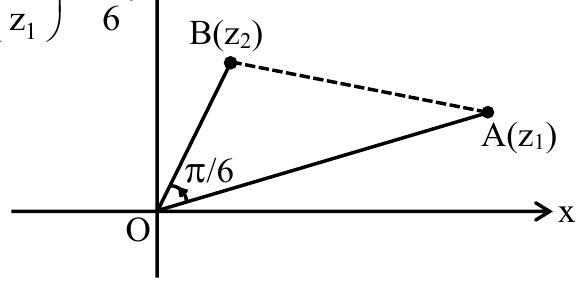
$\left|\mathrm{z}_{1}-\mathrm{z}_{2}\right|=\left|\mathrm{z}_{2}\right| \Rightarrow \Delta \mathrm{ABO}$ is isosceles with angles $\frac{\pi}{6}, \frac{\pi}{6} \& \frac{2 \pi}{3}$ (obtuse angled isosceles triangle)
area of $\triangle \mathrm{ABO}=\frac{1}{2}\left|\mathrm{z}_{1}\right|\left|\mathrm{z}_{2}\right| \sin \frac{\pi}{6}=\frac{\sqrt{11}}{2} \sqrt{\frac{11}{3}} \frac{1}{2}=\frac{11}{4 \sqrt{3}}$30 October, 2026 at 8:11 am in reply to: Let O be the origin, the point A be $\mathrm{z}_{1}=\sqrt{3}+2 \sqrt{2} \mathrm{i}$, the point $\mathrm{B}\left(\mathrm{z}_{2}\right)$ be such that $\sqrt{3}\left|\mathrm{z}_{2}\right|=\left|\mathrm{z}_{1}\right|$ and $\arg \left(\mathrm{z}_{2}\right)=\arg \left(\mathrm{z}_{1}\right)+\frac{\pi}{6}$. Then #12495KeymasterAnswer
B
KeymasterSolution
$\left|\mathrm{z}_{1}-(8+2 \mathrm{i})\right| \leq 1$
$\mathrm{z}_{1}$ is region inside \& circumference of circle,
centre $\mathrm{C}_{1}(8,2)$, radius $\mathrm{r}_{1}=1$
$\left|\mathrm{z}_{2}-2+6 \mathrm{i}\right| \leq 2, \mathrm{z}_{2}$ is region inside \& circumference of circle,
centre $\mathrm{C}_{2}(2,-6)$, radius $\mathrm{r}_{2}=2$
Now $\left|\mathrm{z}_{1}-\mathrm{z}_{2}\right|_{\text {min }}=\mathrm{PQ}=\mathrm{C}_{1} \mathrm{C}_{2}-\mathrm{r}_{1}-\mathrm{r}_{2}$\[ =\sqrt{6^{2}+8^{2}}-1-2=7 \]KeymasterAnswer
C
 30 October, 2026 at 8:11 am in reply to: If the locus of $\mathrm{z} \in \mathrm{C}$, such that $\operatorname{Re}\left(\frac{\mathrm{z}-1}{2 \mathrm{z}+\mathrm{i}}\right)+\operatorname{Re}\left(\frac{\overline{\mathrm{z}}-1}{2 \overline{\mathrm{z}}-\mathrm{i}}\right)=2$, is a circle of radius r and center (a,b), then $\frac{15 \mathrm{ab}}{\mathrm{r}^{2}}$ is equal to #12485Keymaster
Solution
$\operatorname{Re}(\mathrm{z})=\frac{\mathrm{z}+\overline{\mathrm{z}}}{2} \Rightarrow \operatorname{Re}\left(\frac{\mathrm{z}-1}{2 \mathrm{z}+\mathrm{i}}\right)+\operatorname{Re}\left(\frac{\overline{\mathrm{z}}-1}{2 \overline{\mathrm{z}}-\mathrm{i}}\right)=2 \Rightarrow \frac{1}{2}\left[\frac{\mathrm{z}-1}{2 \mathrm{z}+\mathrm{i}}+\left(\frac{\overline{\mathrm{z}-1}}{2 \mathrm{z}+\mathrm{i}}\right)\right]+\frac{1}{2}\left[\frac{\overline{\mathrm{z}}-1}{2 \overline{\mathrm{z}}-\mathrm{i}}+\overline{\left(\frac{\overline{\mathrm{z}}-1}{2 \overline{\mathrm{z}}-\mathrm{i}}\right)}\right]=2$
\[ \begin{aligned} & \Rightarrow \frac{z-1}{2 z+i}+\frac{\bar{z}-1}{2 \bar{z}-i}+\frac{\bar{z}-1}{2 \bar{z}-i}+\frac{z-1}{2 z+i}=4 \Rightarrow \frac{z-1}{2 z+i}+\frac{\bar{z}-1}{2 \bar{z}-i}=2 \Rightarrow(z-1)(2 \bar{z}-i)+(\bar{z}-1)(2 z+i)=2(2 z+i)(2 \bar{z}-i) \\ & \Rightarrow 2 z \bar{z}-i z-2 \bar{z}+i+2 z \bar{z}+\bar{z} i-2 z-i=8 z \bar{z}-4 z i+4 i \bar{z}+2 \Rightarrow 4 z \bar{z}+(2-3 i) z+(2+3 i) \bar{z}+2=0 \Rightarrow 4 z \bar{z}+2(z+\bar{z})-3 i(z-\bar{z})+2=0 \end{aligned} \]let $\mathrm{z}=\mathrm{x}+\mathrm{i}, \overline{\mathrm{z}}=\mathrm{x}-\mathrm{iy} \Rightarrow 4\left(\mathrm{x}^{2}+\mathrm{y}^{2}\right)+4 \mathrm{x}+6 \mathrm{y}+2=0 \Rightarrow \mathrm{x}^{2}+\mathrm{y}^{2}+\mathrm{x}+\frac{3}{2} \mathrm{y}+\frac{1}{2}=0$ centre $\left(-\frac{1}{2},-\frac{3}{4}\right) \equiv(\mathrm{a}, \mathrm{b})$
radius $=\mathrm{r}=\sqrt{\frac{1}{4}+\frac{9}{16}-\frac{1}{2}}=\frac{\sqrt{5}}{4} \therefore \frac{15 \mathrm{ab}}{\mathrm{r}^{2}}=\frac{15\left(-\frac{1}{2}\right)\left(-\frac{3}{4}\right)}{\left(\frac{\sqrt{5}}{4}\right)^{2}}=\frac{45}{8} \times \frac{16}{5}=18$30 October, 2026 at 8:11 am in reply to: If the locus of $\mathrm{z} \in \mathrm{C}$, such that $\operatorname{Re}\left(\frac{\mathrm{z}-1}{2 \mathrm{z}+\mathrm{i}}\right)+\operatorname{Re}\left(\frac{\overline{\mathrm{z}}-1}{2 \overline{\mathrm{z}}-\mathrm{i}}\right)=2$, is a circle of radius r and center (a,b), then $\frac{15 \mathrm{ab}}{\mathrm{r}^{2}}$ is equal to #12486KeymasterAnswer
B
30 October, 2026 at 8:11 am in reply to: Let z be a complex number such that $|z-6|=5$ and $|z+2-6 i|=5$. Then the value of $z^{3}+3 z^{2}-15 z+141$ is equal to #12473KeymasterSolution
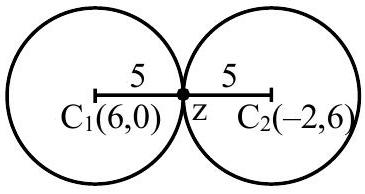
First circle $\mathrm{c}_{1}(6,0) ; \mathrm{r}_{1}=5$, Second circle $\mathrm{C}_{2}(-2,6) ; \mathrm{r}_{2}=5$
$\mathrm{C}_{1} \mathrm{C}_{2}=\sqrt{8^{2}+6^{2}}=10 \therefore \mathrm{C}_{1} \mathrm{C}_{2}=\mathrm{r}_{1}+\mathrm{r}_{2}$ both circles touch each other externally $\mathrm{z}=$ mid point of centres $\mathrm{C}_{1}$ \& $\mathrm{C}_{2}$
$\mathrm{z} \equiv\left(\frac{6-2}{2}, \frac{0+6}{2}\right) \equiv(2,3) ; \mathrm{z}=2+3 \mathrm{i} \Rightarrow \mathrm{z}-2=3 \mathrm{i} \Rightarrow \mathrm{z}^{2}-4 \mathrm{z}+4=9 \mathrm{i}^{2}=-9 \Rightarrow \mathrm{z}^{2}-4 \mathrm{z}=-13$
$\mathrm{z}^{3}-4 \mathrm{z}^{2}=-13 \mathrm{z} \Rightarrow \mathrm{z}^{3}-4(4 \mathrm{z}-13)=-13 \mathrm{z} \Rightarrow \mathrm{z}^{3}=3 \mathrm{z}-52$
Now $z^{3}+3 z^{2}-15 z+141=(3 z-52)+3(4 z-13)-15 z+141=-52-39+141=102-52=50$
 30 October, 2026 at 8:11 am in reply to: Let z be a complex number such that $|z-6|=5$ and $|z+2-6 i|=5$. Then the value of $z^{3}+3 z^{2}-15 z+141$ is equal to #12474Keymaster
Answer
C
30 October, 2026 at 8:11 am in reply to: Let $\mathrm{A}=\{\mathrm{z} \in \mathrm{C}:|\mathrm{z}-2| \leq 4\}$ and $\mathrm{B}=\{\mathrm{z} \in \mathrm{C}:|\mathrm{z}-2|+|\mathrm{z}+2|=5\}$. Then the max $\left\{\left|\mathrm{z}_{1}-\mathrm{z}_{2}\right|: \mathrm{z}_{1} \in \mathrm{~A}\right.$ and $\left.\mathrm{z}_{2} \in \mathrm{~B}\right\}$ is #12476KeymasterSolution
Set A: $|\mathrm{z}-2| \leq 4 \Rightarrow \mathrm{Z}_{1}$ represents interior and

circumference of circle whose
Centre $(2,0)$ and radius $\mathrm{r}=4$
Set B: $|\mathrm{z}-2|+|\mathrm{z}+2|=5$\[ \mathrm{PS}_{1}+\mathrm{PS}_{2}=\ell_{\text {major axis }}=2 \mathrm{a}=5 \]$\mathrm{Z}_{2}$ represents Ellipse with centre origin and major axis as x axis
$\left|\mathrm{z}_{1}-\mathrm{z}_{2}\right|_{\text {max }}=6-\left(-\frac{5}{2}\right)=\frac{17}{2}=$ shortest distance between ellipse and circle lies along x-axis30 October, 2026 at 8:11 am in reply to: Let $\mathrm{A}=\{\mathrm{z} \in \mathrm{C}:|\mathrm{z}-2| \leq 4\}$ and $\mathrm{B}=\{\mathrm{z} \in \mathrm{C}:|\mathrm{z}-2|+|\mathrm{z}+2|=5\}$. Then the max $\left\{\left|\mathrm{z}_{1}-\mathrm{z}_{2}\right|: \mathrm{z}_{1} \in \mathrm{~A}\right.$ and $\left.\mathrm{z}_{2} \in \mathrm{~B}\right\}$ is #12477KeymasterAnswer
C
30 October, 2026 at 8:11 am in reply to: Let z be a complex number such that $|\mathrm{z}|=1$. If $\frac{2+\mathrm{k}^{2} \mathrm{z}}{\mathrm{k}+\overline{\mathrm{z}}}=\mathrm{kz}, \mathrm{k} \in \mathrm{R}$, then the maximum distance of $\mathrm{k}+\mathrm{ik}^{2}$ from the circle $|\mathrm{z}-(1+2 \mathrm{i})|=1$ is #12479KeymasterSolution
$\frac{2+\mathrm{k}^{2} \mathrm{z}}{\mathrm{k}+\overline{\mathrm{z}}}=\mathrm{kz} \Rightarrow 2+\mathrm{k}^{2} \mathrm{z}=\mathrm{k}^{2} \mathrm{z}+\mathrm{kz} \overline{\mathrm{z}}$
\[ \begin{aligned} & \Rightarrow|\mathrm{z}|^{2} \mathrm{k}=2 \Rightarrow \mathrm{k}=2(\because|\mathrm{z}|=1) \\ & \mathrm{k}+\mathrm{ik}^{2}=2+4 \mathrm{i}, \operatorname{Point}(2,4) \end{aligned} \]circle $|\mathrm{z}-1-2 \mathrm{i}|=1$, centre $\mathrm{C}(1,2)$, radius $\mathrm{r}=1$
Required maximum distance $=\mathrm{PQ}=\mathrm{PC}+\mathrm{r}=\sqrt{1+4}+1=\sqrt{5}+1$30 October, 2026 at 8:11 am in reply to: Let z be a complex number such that $|\mathrm{z}|=1$. If $\frac{2+\mathrm{k}^{2} \mathrm{z}}{\mathrm{k}+\overline{\mathrm{z}}}=\mathrm{kz}, \mathrm{k} \in \mathrm{R}$, then the maximum distance of $\mathrm{k}+\mathrm{ik}^{2}$ from the circle $|\mathrm{z}-(1+2 \mathrm{i})|=1$ is #12480KeymasterAnswer
A

-
AuthorPosts