

Forum Replies Created
-
AuthorPosts
-
UPLIFTJEE
KeymasterSolution
According to the question, $|\mathrm{z}-1| \leq 1 \Rightarrow|(\mathrm{x}-1)+\mathrm{iy}| \leq 1 \Rightarrow \sqrt{(\mathrm{x}-1)^{2}+\mathrm{y}^{2}} \leq 1$
\[ \begin{aligned} & \Rightarrow(\mathrm{x}-1)^{2}+\mathrm{y}^{2} \leq 1 \quad \ldots(1) \text { Also }|\mathrm{z}-5| \leq|\mathrm{z}-5 \mathrm{i}| \\ & \Rightarrow(\mathrm{x}-5)^{2}+\mathrm{y}^{2} \leq \mathrm{x}^{2}+(\mathrm{y}-5)^{2} \\ & -10 \mathrm{x} \leq-10 \mathrm{y} \Rightarrow \mathrm{x} \geq \mathrm{y} \quad \ldots(2) \text { Solving (1) and (2) } \\ & \Rightarrow(\mathrm{x}-1)^{2}+\mathrm{x}^{2}=1 \Rightarrow 2 \mathrm{x}^{2}-2 \mathrm{x}=0 \Rightarrow \mathrm{x}(\mathrm{x}-1)=0 \Rightarrow \mathrm{x}=0 \text { or } \mathrm{x}=1 \end{aligned} \]$\mathrm{y}=0$ or $\mathrm{y}=1$ Given $\mathrm{x}, \mathrm{y} \in \mathrm{I}$
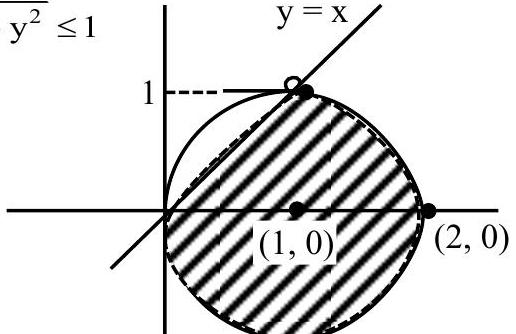
Points (0, 0), (1, 0), (2, 0), (1, 1), (1, -1)
Now $\left|\mathrm{z}_{1}\right|^{2}+\left|\mathrm{z}_{2}\right|^{2}+\left|\mathrm{z}_{3}\right|^{2}+\left|\mathrm{z}_{4}\right|^{2}+\left|\mathrm{z}_{5}\right|^{2}$\[ =0+1+4+(1+1)+(1+1)=9 \]KeymasterAnswer
9
30 October, 2026 at 8:11 am in reply to: Let $\mathrm{P}=\{\mathrm{z} \in \mathrm{C}:|\mathrm{z}+2-3 \mathrm{i}| \leq 1\}$ and $\mathrm{Q}=\{\mathrm{z} \in \mathrm{C}: \mathrm{z}(1+\mathrm{i})+\overline{\mathrm{z}}(1-\mathrm{i}) \leq-8\}$. Let in $\mathrm{P} \cap \mathrm{Q},|\mathrm{z}-3+2 \mathrm{i}|$ be maximum and minimum at $z_{1}$ and $z_{2}$ respectively. If $\left|z_{1}\right|^{2}+2\left|z_{2}\right|^{2}=\alpha+\beta \sqrt{2}$, where $\alpha, \beta$ are integers, then $\alpha+\beta$ equals #12512KeymasterSolution
Shaded region is $\mathrm{P} \cap \mathrm{Q}$. where z lies
Clearly for the shaded region $\mathrm{z}_{1}$ is the intersection of the circle and the line passing through $\mathrm{P}\left(\mathrm{L}_{1}\right)$ and $\mathrm{z}_{2}$ is intersection ofline $\mathrm{L}_{1}$ \& $\mathrm{L}_{2}$\[ \begin{aligned} & \mathrm{P}:|\mathrm{z}+2-3 \mathrm{i}| \leq 1 \text { Circle : }(\mathrm{x}+2)^{2}+(\mathrm{y}-3)^{2} \leq 1, \mathrm{C}_{0}(-2,3) \\ & \mathrm{Q}: \mathrm{z}(1+\mathrm{i})+\bar{z}(1-\mathrm{i}) \leq-8 \\ & \Rightarrow(\mathrm{z}+\bar{z})+\mathrm{i}(\mathrm{z}-\bar{z}) \leq-8 \\ & \Rightarrow 2 \mathrm{x}+\mathrm{i}(2 \mathrm{yi}) \leq-8 \Rightarrow \mathrm{x}-\mathrm{y} \leq-4 \end{aligned} \]$|\mathrm{z}-(3-2 \mathrm{i})|=$ distance between z and point $\mathrm{D}(3,-2)$
For minimum \& maximum required distance lies along common normal of line L and circle.
So, common normal through D is $\mathrm{x}+\mathrm{y}-1=0$, which cuts circle at B and passing through centre of circle

line $\mathrm{AB} \perp$ line L
For position $\mathrm{A},|\mathrm{z}-3+2 \mathrm{i}|_{\text {min }}=\mathrm{AD}$ where A is point of intersection of line $\mathrm{L}: \mathrm{x}-\mathrm{y}+4=0$ and $\mathrm{x}+\mathrm{y}-1=0$\[ \mathrm{A}\left(-\frac{3}{2}, \frac{5}{2}\right),\left|\mathrm{z}_{2}\right|=\mathrm{OA}=\sqrt{\frac{9+25}{4}}=\frac{\sqrt{17}}{\sqrt{2}} \text { For } \mathrm{B},|\mathrm{z}-3+2 \mathrm{i}|_{\max }=\mathrm{BD}=\mathrm{C}_{0} \mathrm{D}+\mathrm{r}=1+5 \sqrt{2} \Rightarrow \frac{\mathrm{x}-3}{-1 / \sqrt{2}}=\frac{\mathrm{y}+2}{1 / \sqrt{2}}=1+5 \sqrt{2} \]\[ \begin{aligned} & B: z_{1}\left(-2-\frac{1}{\sqrt{2}}, 3+\frac{1}{\sqrt{2}}\right) \Rightarrow\left|z_{1}\right|=\sqrt{\left(-2-\frac{1}{\sqrt{2}}\right)^{2}+\left(3+\frac{1}{\sqrt{2}}\right)^{2}}=\sqrt{4+9+\frac{4}{\sqrt{2}}+\frac{6}{\sqrt{2}}+1}=\sqrt{14+5 \sqrt{2}} \\ & \left|z_{1}\right|^{2}+2\left|z_{2}\right|^{2}=14+5 \sqrt{2}+2\left(\frac{17}{2}\right)=31+5 \sqrt{2}=\alpha+\beta \sqrt{2} \Rightarrow \alpha=31, \beta=5 \text { we get } \alpha+\beta=36 \end{aligned} \]30 October, 2026 at 8:11 am in reply to: Let $\mathrm{P}=\{\mathrm{z} \in \mathrm{C}:|\mathrm{z}+2-3 \mathrm{i}| \leq 1\}$ and $\mathrm{Q}=\{\mathrm{z} \in \mathrm{C}: \mathrm{z}(1+\mathrm{i})+\overline{\mathrm{z}}(1-\mathrm{i}) \leq-8\}$. Let in $\mathrm{P} \cap \mathrm{Q},|\mathrm{z}-3+2 \mathrm{i}|$ be maximum and minimum at $z_{1}$ and $z_{2}$ respectively. If $\left|z_{1}\right|^{2}+2\left|z_{2}\right|^{2}=\alpha+\beta \sqrt{2}$, where $\alpha, \beta$ are integers, then $\alpha+\beta$ equals #12513KeymasterAnswer
36
KeymasterSolution
According to the question, Put $\mathrm{z}=\mathrm{x}+\mathrm{iy} \Rightarrow(\mathrm{z}+\overline{\mathrm{z}})+\mathrm{i}(\mathrm{z}-\overline{\mathrm{z}}) \leq 2 \Rightarrow 2 \mathrm{x}+\mathrm{i}(2 \mathrm{iy}) \leq 2$
\[ \begin{aligned} & \Rightarrow \mathrm{x}-\mathrm{y} \leq 1 \\ & |\mathrm{z}-1| \leq 2 \end{aligned} \]interior part of circle with centre $(1,0)$ and $\mathrm{r}=2$
\[ \operatorname{Im}(\mathrm{z}) \geq 0 \Rightarrow \mathrm{y} \geq 0 \]Required area = Area of semi-circle-area of sector $\mathrm{A}=\frac{1}{2} \pi(2)^{2}-\frac{\pi^{2}}{2}\left(\frac{\pi}{4}\right)=\frac{3 \pi}{2}$
 Keymaster
Answer
D
30 October, 2026 at 8:11 am in reply to: If z is a complex number such that $|\mathrm{z}| \geq 1$, then the minimum value of $\left|\mathrm{z}+\frac{1}{2}(3+4 \mathrm{i})\right|$ is #12503KeymasterSolution
According to the question,

$|\mathrm{z}| \geq 1, \mathrm{z}$ lies on or outside the circle whose radius is 1 and centre $(0,0)$
$\left|\mathrm{z}+\frac{1}{2}(3+4 \mathrm{i})\right|=\left|\mathrm{z}-\frac{1}{2}(-3-4 \mathrm{i})\right|=$ distance between z and $\left(-\frac{3}{2},-2\right)$
Min. value of $\left|\mathrm{z}+\frac{3}{2}+2 \mathrm{i}\right|$ is zero
No options are matched so this question was dropped30 October, 2026 at 8:11 am in reply to: If z is a complex number such that $|\mathrm{z}| \geq 1$, then the minimum value of $\left|\mathrm{z}+\frac{1}{2}(3+4 \mathrm{i})\right|$ is #12504KeymasterAnswer
Bonus
30 October, 2026 at 8:11 am in reply to: Let the complex numbers $\alpha$ and $\frac{1}{\bar{\alpha}}$ lie on the circles $\left|\mathrm{z}-\mathrm{z}_{0}\right|^{2}=4$ and $\left|\mathrm{z}-\mathrm{z}_{0}\right|^{2}=16$ respectively, where $\mathrm{z}_{0}=1+\mathrm{i}$. Then, the value of $100|\alpha|^{2}$ is #12506KeymasterSolution
$\alpha$ satisfies equation $\left|z-z_{0}\right|^{2}=4 \Rightarrow\left|\alpha-z_{0}\right|^{2}=4\left(\because|z|^{2}-z \bar{z}\right)$
\[ \begin{aligned} & \Rightarrow\left(\alpha-z_{0}\right)\left(\bar{\alpha}-\bar{z}_{0}\right)=4 \Rightarrow \alpha \bar{\alpha}-\alpha \bar{z}_{0}-z_{0} \bar{\alpha}+\left|z_{0}\right|^{2}=4\left(\because\left|z_{0}\right|=\sqrt{2}\right) \\ & \Rightarrow|\alpha|^{2}-\alpha \bar{z}_{0}-z_{0} \bar{\alpha}=2 \end{aligned} \]$\left|\mathrm{z}-\mathrm{z}_{0}\right|^{2}=16$ is satisfied by $\frac{1}{\bar{\alpha}} \Rightarrow\left(\mathrm{z}-\mathrm{z}_{0}\right)\left(\overline{\mathrm{z}}-\overline{\mathrm{z}}_{0}\right)=\left(\frac{1}{\bar{\alpha}}-\mathrm{z}_{0}\right)\left(\frac{1}{\alpha}-\overline{\mathrm{z}}_{0}\right)=16$
\[ \begin{aligned} & \Rightarrow\left(1-\bar{\alpha} z_{0}\right)\left(1-\alpha \bar{z}_{0}\right)=16 \alpha \bar{\alpha} \Rightarrow 1-\bar{\alpha} z_{0}-\alpha \bar{z}_{0}+\alpha \bar{\alpha} z_{0} \bar{z}_{0}=16 \alpha \bar{\alpha} \text { using (1) } \\ & \Rightarrow 1+2-|\alpha|^{2}+|\alpha|^{2}\left|z_{0}\right|^{2}=16|\alpha|^{2} \Rightarrow 3-|\alpha|^{2}+2|\alpha|^{2}=16|\alpha|^{2} \Rightarrow 15|\alpha|^{2}=3 \Rightarrow 5|\alpha|^{2}=1 \Rightarrow 100|\alpha|^{2}=20 \end{aligned} \]30 October, 2026 at 8:11 am in reply to: Let the complex numbers $\alpha$ and $\frac{1}{\bar{\alpha}}$ lie on the circles $\left|\mathrm{z}-\mathrm{z}_{0}\right|^{2}=4$ and $\left|\mathrm{z}-\mathrm{z}_{0}\right|^{2}=16$ respectively, where $\mathrm{z}_{0}=1+\mathrm{i}$. Then, the value of $100|\alpha|^{2}$ is #12507KeymasterAnswer
20
30 October, 2026 at 8:11 am in reply to: If $\alpha$ denotes the number of solutions of $|1-\mathrm{i}|^{\mathrm{x}}=2^{\mathrm{x}}$ and $\beta=\left(\frac{|\mathrm{z}|}{\arg (\mathrm{z})}\right)$, where $\mathrm{z}=\frac{\pi}{4}(1+\mathrm{i})^{4}\left[\frac{1-\sqrt{\pi \mathrm{i}}}{\sqrt{\pi}+\mathrm{i}}+\frac{\sqrt{\pi}-\mathrm{i}}{1+\sqrt{\pi \mathrm{i}}}\right], \mathrm{i}=\sqrt{-1}$ then the distance of the point $(\alpha, \beta)$ from the line $4 \mathrm{x}-3 \mathrm{y}=7$ is #12509KeymasterSolution
$|1-\mathrm{i}|^{\mathrm{x}}=(\sqrt{2})^{\mathrm{x}}=2^{\mathrm{x}} \Rightarrow \mathrm{x}=0$ one solution, hence $\alpha=1$
\[ \begin{aligned} & z=\frac{\pi}{4}(1+i)^{4}\left[\frac{1-\sqrt{\pi i}}{\sqrt{\pi}+i}+\frac{\sqrt{\pi}-i}{1+\sqrt{\pi} i}\right] \Rightarrow z=\frac{\pi}{4}(2 i)^{2}\left[\frac{(1-\sqrt{\pi} i)}{(\sqrt{\pi}+i)} \frac{(\sqrt{\pi}-i)}{(\sqrt{\pi}-i)}+\frac{(\sqrt{\pi}-i)}{(\sqrt{\pi}+i)} \frac{(1-\sqrt{\pi} i)}{(1-\sqrt{\pi} i)}\right] \\ & z=-\pi\left[\frac{\sqrt{\pi}-\pi i-i-\sqrt{\pi}}{\pi+1}+\frac{\sqrt{\pi}-i-\pi i-\sqrt{\pi}}{1+\pi}\right] \Rightarrow z=-\pi(-2 i)=2 \pi i \\ & \beta=\left(\frac{|z|}{\arg (z)}\right)=\frac{2 \pi}{\pi / 2}=4 \text { Distance of point }(\alpha, \beta) \equiv(1,4) \text { from line } 4 x-3 y-7=0=\left|\frac{4-12-7}{\sqrt{16+9}}\right|=\frac{15}{5}=3 \end{aligned} \]30 October, 2026 at 8:11 am in reply to: If $\alpha$ denotes the number of solutions of $|1-\mathrm{i}|^{\mathrm{x}}=2^{\mathrm{x}}$ and $\beta=\left(\frac{|\mathrm{z}|}{\arg (\mathrm{z})}\right)$, where $\mathrm{z}=\frac{\pi}{4}(1+\mathrm{i})^{4}\left[\frac{1-\sqrt{\pi \mathrm{i}}}{\sqrt{\pi}+\mathrm{i}}+\frac{\sqrt{\pi}-\mathrm{i}}{1+\sqrt{\pi \mathrm{i}}}\right], \mathrm{i}=\sqrt{-1}$ then the distance of the point $(\alpha, \beta)$ from the line $4 \mathrm{x}-3 \mathrm{y}=7$ is #12510KeymasterAnswer
3
30 October, 2026 at 8:11 am in reply to: If $\mathrm{S}=\{\mathrm{z} \in \mathrm{C}:|\mathrm{z}-\mathrm{i}|=|\mathrm{z}+\mathrm{i}|=|\mathrm{z}-1|\}$, then, $\mathrm{n}(\mathrm{S})$ is : #12500KeymasterSolution
According to the question,
\[ |\mathrm{z}-\mathrm{i}|=|\mathrm{z}+\mathrm{i}|=|\mathrm{z}-1| \]ABC is a triangle. Hence its circumcentre is
the only point whose distance from A, B, C will be same
So $\mathrm{n}(\mathrm{S})=1$30 October, 2026 at 8:11 am in reply to: If $\mathrm{S}=\{\mathrm{z} \in \mathrm{C}:|\mathrm{z}-\mathrm{i}|=|\mathrm{z}+\mathrm{i}|=|\mathrm{z}-1|\}$, then, $\mathrm{n}(\mathrm{S})$ is : #12501KeymasterAnswer
A
 30 October, 2026 at 8:11 am in reply to: Let $\left|\frac{\bar{z}-\mathrm{i}}{2 \bar{z}+\mathrm{i}}\right|=\frac{1}{3}, \mathrm{z} \in \mathrm{C}$, be the equation of a circle with center at C. If the area of the triangle, whose vertices are at the points (0, 0), C and $(\alpha, 0)$ is 11 square units, then $\alpha^{2}$ equals #12491Keymaster
Solution
$\left|\frac{\bar{z}-\mathrm{i}}{2 \bar{z}+\mathrm{i}}\right|=\frac{1}{3} \Rightarrow\left|\frac{\bar{z}-\mathrm{i}}{\bar{z}+\frac{\mathrm{i}}{2}}\right|=\frac{2}{3} \Rightarrow 3|\mathrm{x}-\mathrm{iy}-\mathrm{i}|=2\left|\mathrm{x}-\mathrm{iy}+\frac{\mathrm{i}}{2}\right|$
\[ \Rightarrow 9\left(x^{2}+(y+1)^{2}\right)=4\left(x^{2}+(y-1 / 2)^{2}\right) \Rightarrow 9 x^{2}+9 y^{2}+18 y+9=4 x^{2}+4 y^{2}-4 y+1 \Rightarrow 5 x^{2}+5 y^{2}+22 y+8=0 \]\[ \begin{aligned} & \Rightarrow \mathrm{x}^{2}+\mathrm{y}^{2}+\frac{22}{5} \mathrm{y}+\frac{8}{5}=0 \text { centre } \mathrm{C}\left(0,-\frac{11}{5}\right) \text { Area of triangle formed by }(0,0),\left(0,-\frac{11}{5}\right) \text { and }(\alpha, 0) \text { is }\left|\frac{1}{2}\right| \begin{array}{ccc} 0 & 0 & 1 \\ 0 & -11 / 5 & 1 \\ \alpha & 0 & 1 \end{array}|\mid=11 \\ & \Rightarrow\left(\frac{11}{5} \alpha\right)^{2}=(11 \times 2)^{2} \Rightarrow \alpha^{2}=100 \end{aligned} \] -
AuthorPosts