

Forum Replies Created
-
AuthorPosts
-
UPLIFTJEE
KeymasterSolution
let $\mathrm{z}=\mathrm{x}+\mathrm{iy}, \overline{\mathrm{z}}=\mathrm{x}-\mathrm{iy} \Rightarrow \overline{\mathrm{z}}^{2}=\mathrm{x}^{2}-\mathrm{y}^{2}-2 \mathrm{ixy} \Rightarrow(\overline{\mathrm{z}})^{2}+|\mathrm{z}|=0$
\[ \Rightarrow x^{2}-y^{2}-2 i x y+\sqrt{x^{2}+y^{2}}=0 \Rightarrow x^{2}-y^{2}+\sqrt{x^{2}+y^{2}}-2 x y i=0 \Rightarrow x^{2}-y^{2}+\sqrt{x^{2}+y^{2}}=0 \text { and } x y=0 \]Case $\mathrm{I}: \mathrm{x}=0 \quad$ Case II : $\mathrm{y}=0$
\[ \begin{array}{ll} -\mathrm{y}^{2}+|\mathrm{y}|=0 \Rightarrow|\mathrm{y}|=|\mathrm{y}|^{2} & \mathrm{x}^{2}+|\mathrm{x}|=0 \\ \Rightarrow|\mathrm{y}|(|\mathrm{y}|-1)=0 & \Rightarrow \mathrm{x}=0 \\ \Rightarrow \mathrm{y}=0, \pm 1 & \Rightarrow \mathrm{z}=0 \end{array} \]$\mathrm{z}=0, \mathrm{i},-\mathrm{i}$ are roots $\alpha=\mathrm{i}-\mathrm{i}=0 ; \beta=\mathrm{i}(-\mathrm{i})=1 \Rightarrow 4\left(\alpha^{2}+\beta^{2}\right)=4(0+1)=4$
KeymasterAnswer
C
22 October, 2026 at 6:00 pm in reply to: The number of complex numbers z, satisfying $|z|=1$ and $\left|\frac{z}{\bar{z}}+\frac{\bar{z}}{z}\right|=1$, is #12319KeymasterSolution
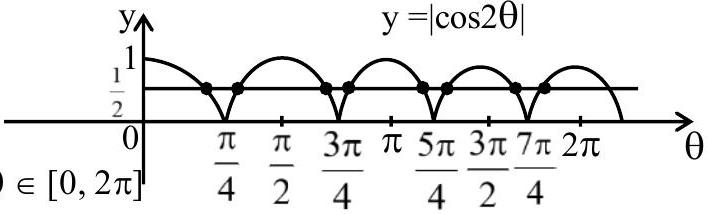
As $|\mathrm{z}|=\mathrm{r}=1$ so we have $\mathrm{z}=\mathrm{e}^{\mathrm{i} \theta}$ and $\frac{\mathrm{z}}{\overline{\mathrm{z}}}=\mathrm{e}^{\mathrm{i} 2 \theta}$
\[ \left|\frac{\mathrm{z}}{\overline{\mathrm{z}}}+\frac{\overline{\mathrm{z}}}{\mathrm{z}}\right|=\left|\mathrm{e}^{\mathrm{i} 2 \theta}+\mathrm{e}^{-\mathrm{i} 2 \theta}\right|=1 \Rightarrow|\cos 2 \theta|=\frac{1}{2} \]From graph we can conclude that given equation has 8 solution if $\theta \in[0,2 \pi]^{\mathrm{l}}$
 22 October, 2026 at 6:00 pm in reply to: The number of complex numbers z, satisfying $|z|=1$ and $\left|\frac{z}{\bar{z}}+\frac{\bar{z}}{z}\right|=1$, is #12320Keymaster
Answer
A
KeymasterSolution
$\alpha+\beta=a, \alpha \beta=-b \Rightarrow P_{6}=a P_{5}+b P_{4} \Rightarrow 45 \sqrt{7} i=a \times 11 \sqrt{7} i+b(-3 \sqrt{7}) i$
\[ \begin{aligned} & 45=11 \mathrm{a}-3 \mathrm{~b} \quad \ldots(1) \text { and } \mathrm{P}_{5}=\mathrm{aP}_{4}+\mathrm{bP}_{3} \\ & 11 \sqrt{7} \mathrm{i}=\mathrm{a}(-3 \sqrt{7} \mathrm{i})+\mathrm{b}(-5 \sqrt{7} \mathrm{i}) \Rightarrow 11=-3 \mathrm{a}-5 \mathrm{~b} \quad \ldots(2) \Rightarrow \mathrm{a}=3, \mathrm{~b}=-4 \text { we get } \mathrm{x}^{2}-3 \mathrm{x}+4=0 \text { with roots } \alpha \text { and } \beta \\ & \alpha+\beta=3, \alpha \beta=4 \Rightarrow\left|\alpha^{4}+\beta^{4}\right|=\left|\left(\alpha^{2}+\beta^{2}\right)^{2}-2 \alpha^{2} \beta^{2}\right|=\left|\left((\alpha+\beta)^{2}-2 \alpha \beta\right)^{2}-2(\alpha \beta)^{2}\right|=\left|\left(3^{2}-8\right)^{2}-2 \cdot 4^{2}\right|=\|-32 \mid=31 \end{aligned} \]KeymasterAnswer
31
22 October, 2026 at 6:00 pm in reply to: If $\alpha$ and $\beta$ are theroots of theequation $2 z^{2}-3 z-2 i=0$, where $i=\sqrt{-1}$, #12325KeymasterSolution
$2 \mathrm{z}^{2}-3 \mathrm{z}-2 \mathrm{i}=0 \Rightarrow 2\left(\mathrm{z}-\frac{\mathrm{i}}{\mathrm{z}}\right)=3$
\[ \alpha-\frac{\mathrm{i}}{\alpha}=\frac{3}{2} \Rightarrow \alpha^{2}-\frac{1}{\alpha^{2}}-2 \mathrm{i}=\frac{9}{4} \Rightarrow \frac{9}{4}+2 \mathrm{i}=\alpha^{2}-\frac{1}{\alpha^{2}} \Rightarrow \frac{81}{16}-4+9 \mathrm{i}=\alpha^{4}+\frac{1}{\alpha^{4}}-2 \Rightarrow \frac{49}{16}+9 \mathrm{i}=\alpha^{4}+\frac{1}{\alpha^{4}} \]Similarly $\frac{49}{16}+9 \mathrm{i}=\beta^{4}+\frac{1}{\beta^{4}} \Rightarrow \frac{\alpha^{19}+\beta^{19}+\alpha^{11}+\beta^{11}}{\alpha^{15}+\beta^{15}}=\frac{\alpha^{15}\left(\alpha^{4}+\frac{1}{\alpha^{4}}\right)+\beta^{15}\left(\beta^{4}+\frac{1}{\beta^{4}}\right)}{\alpha^{15}+\beta^{15}}=\frac{\left(\alpha^{15}+\beta^{15}\right)\left(\frac{49}{16}+9 \mathrm{i}\right)}{\left(\alpha^{15}+\beta^{15}\right)}=\frac{49}{16}+9 \mathrm{i}$ Real Part $=\frac{49}{16}$ and Imaginary Part $=9$ Required term $=16\left(\frac{49}{16}\right)(9)=49 \times 9=441$
22 October, 2026 at 6:00 pm in reply to: If $\alpha$ and $\beta$ are theroots of theequation $2 z^{2}-3 z-2 i=0$, where $i=\sqrt{-1}$, #12326KeymasterAnswer
A
KeymasterSolution
$|\mathrm{z}+1|=\alpha \mathrm{z}+\beta(1+\mathrm{i})$, put $\mathrm{z}=\frac{1}{2}-2 \mathrm{i} \Rightarrow\left|\frac{3}{2}-2 \mathrm{i}\right|=\frac{\alpha}{2}-2 \alpha \mathrm{i}+\beta+\beta \mathrm{i} \Rightarrow \sqrt{\frac{9}{4}+4}=\frac{5}{2}=\left(\frac{\alpha}{2}+\beta\right)+(\beta-2 \alpha) \mathrm{i}$
Comparing real and imaginary parts $\frac{\alpha}{2}+\beta=\frac{5}{2}$ and $\beta=2 \alpha \Rightarrow \frac{\alpha}{2}+2 \alpha=\frac{5}{2} \Rightarrow \alpha=1, \beta=2$. Now, $\alpha+\beta=3$KeymasterAnswer
D
KeymasterSolution
$\mathrm{x}^{2}-(3-2 \mathrm{i}) \mathrm{x}-(2 \mathrm{i}-2)=0$
\[ \begin{aligned} & x=\frac{(3-2 i) \pm \sqrt{(3-2 i)^{2}-4(1)(-(2 i-2))}}{2(1)}=\frac{3-2 i \pm \sqrt{-3-4 i}}{2} \\ & x=\frac{3-2 i \pm \sqrt{(1)^{2}+(2 i)^{2}-2(1)(2 i)}}{2}=\frac{3-2 i \pm(1-2 i)}{2} \Rightarrow x=2-2 i \text { or } 1+0 i \end{aligned} \]According to question $\alpha+\beta \mathrm{i}=2-2 \mathrm{i}$ and $\gamma+\delta \mathrm{i}=1+\mathrm{i} .0$ we get $\alpha=2, \beta=-2, \gamma=1, \delta=0$ So, $\alpha \gamma+\beta \delta=2(1)+(-2)(0)=2$
KeymasterAnswer
D
KeymasterSolution
$1+10 \operatorname{Re}\left(\frac{2 \cos \theta+\mathrm{i} \sin \theta}{\cos \theta-3 \mathrm{i} \sin \theta}\right)=0(\therefore 2 \operatorname{Re}(\mathrm{z})=\mathrm{z}+\overline{\mathrm{z}})$
\[ \begin{aligned} & \Rightarrow 1+5\left(\frac{2 \cos \theta+\mathrm{i} \sin \theta}{\cos \theta-3 \mathrm{i} \sin \theta}+\frac{2 \cos \theta-\mathrm{i} \sin \theta}{\cos \theta+3 \mathrm{i} \sin \theta}\right)=0 \\ & \Rightarrow \frac{\left(2 \cos ^{2} \theta-3 \sin ^{2} \theta\right)+\left(2 \cos ^{2} \theta\right)-\left(3 \sin ^{2} \theta\right)}{\cos ^{2} \theta+9 \sin ^{2} \theta}=-\frac{1}{5} \\ & \Rightarrow \frac{2 \cos ^{2} \theta-3 \sin ^{2} \theta}{\cos ^{2} \theta+9 \sin ^{2} \theta}=-\frac{1}{10} \Rightarrow 20 \cos ^{2} \theta-30 \sin ^{2} \theta=-\cos ^{2} \theta-9 \sin ^{2} \theta \\ & \Rightarrow 21 \cos ^{2} \theta-21 \sin ^{2} \theta=0 \Rightarrow \cos 2 \theta=0 \text { As } \theta \in[0,2 \pi] \\ & \Rightarrow 2 \theta=\frac{\pi}{2}, \frac{3 \pi}{2}, \frac{5 \pi}{2}, \frac{7 \pi}{2} \end{aligned} \]Now $\sum_{\theta \in \mathrm{A}} \theta^{2}=\frac{\pi^{2}}{16}+\frac{9 \pi^{2}}{16}+\frac{25 \pi^{2}}{16}+\frac{49 \pi^{2}}{16}=\frac{84 \pi^{2}}{16}=\frac{21 \pi^{2}}{4}$
KeymasterAnswer
A
22 October, 2026 at 6:00 pm in reply to: Let $\mathrm{z}_{1}, \mathrm{z}_{2}$ and $\mathrm{z}_{3}$ be three complex numbers on the circle $|\mathrm{z}|=1$ with $\arg \left(\mathrm{z}_{1}\right)=-\frac{\pi}{4}, \arg \left(\mathrm{z}_{2}\right)=0$ and $\arg \left(\mathrm{z}_{3}\right)=\frac{\pi}{4}$. #12313KeymasterSolution
$\mathrm{z}_{1}=\mathrm{e}^{-\mathrm{i} \pi 4}, \mathrm{z}_{2}=1, \mathrm{z}_{3}=\mathrm{e}^{\mathrm{i} \pi / 4} \Rightarrow\left|\mathrm{z}_{1} \overline{\mathrm{z}}_{2}+\mathrm{z}_{2} \overline{\mathrm{z}}_{3}+\mathrm{z}_{3} \overline{\mathrm{z}}_{1}\right|^{2}=\left|\mathrm{e}^{-\mathrm{i} \frac{\pi}{4}} \times 1+1 \times \mathrm{e}^{-\mathrm{i} \frac{\pi}{4}}+\mathrm{e}^{\mathrm{i} \frac{\pi}{4}} \times \mathrm{e}^{\mathrm{i} \frac{\pi}{4}}\right|^{2}$
\[ \begin{aligned} & =\left|\mathrm{e}^{-\mathrm{i} \frac{\pi}{4}}+\mathrm{e}^{-\mathrm{i} \frac{\pi}{4}}+\mathrm{e}^{\mathrm{i} \frac{\pi}{2}}\right|^{2}=\left|2 \mathrm{e}^{-\mathrm{i} \frac{\pi}{4}}+\mathrm{i}\right|^{2}=|\sqrt{2}-\sqrt{2} \mathrm{i}+\mathrm{i}|^{2}=(\sqrt{2})^{2}+(1-\sqrt{2})^{2}=2+1+2-2 \sqrt{2}=5-2 \sqrt{2} \\ & \alpha=5, \beta=-2 \Rightarrow \alpha^{2}+\beta^{2}=29 \end{aligned} \] -
AuthorPosts