
shahkb4

Forum Replies Created
-
AuthorPosts
-
Solution
$\overrightarrow{\mathrm{c}}=\overrightarrow{\mathrm{a}} \times \hat{\mathrm{b}}=\left|\begin{array}{ccc}\hat{\lambda} & \hat{\mathrm{j}} & \hat{\mathrm{k}} \\ 2 & -1 & 1 \\ 0 & \lambda & 2\end{array}\right|=(-2-\lambda) \hat{\mathrm{i}}-4 \hat{\mathrm{j}}+2 \lambda \hat{\mathrm{k}}$
$|\overrightarrow{\mathrm{c}}|=\sqrt{53}=\sqrt{(-2-\lambda)^{2}+16+4 \lambda^{2}}$
$\Rightarrow 53=4+\lambda^{2}+4 \lambda+16+4 \lambda^{2}$
$\Rightarrow 5 \lambda^{2}+4 \lambda-33=0 \Rightarrow(5 \lambda-11)(\lambda+3)=0$
$\lambda=11 / 5$ (reject) $\lambda=-3$ (accept); $\lambda \in \mathrm{Z}$
$\overrightarrow{\mathrm{c}}=\hat{\mathrm{i}}-4 \hat{\mathrm{j}}-6 \hat{\mathrm{k}}$
let $\vec{d}=x \hat{i}+y \hat{j}+z \hat{k}$
$\overrightarrow{\mathrm{d}}$ lies in yz plane, $\mathrm{x}=0$
$\overrightarrow{\mathrm{d}}=y \hat{\mathrm{j}}+z \hat{\mathrm{k}}$
$|\overrightarrow{\mathrm{d}}|=2=\sqrt{\mathrm{y}^{2}+\mathrm{z}^{2}} \Rightarrow \mathrm{y}^{2}+\mathrm{z}^{2}=4$
$\overrightarrow{\mathrm{c}} \cdot \overrightarrow{\mathrm{d}}=|\overrightarrow{\mathrm{c}} \| \overrightarrow{\mathrm{d}}| \cos \theta$
$\Rightarrow(\overrightarrow{\mathrm{c}} \cdot \overrightarrow{\mathrm{d}})^{2}=|\overrightarrow{\mathrm{c}}|^{2}|\overrightarrow{\mathrm{~d}}|^{2} \cos ^{2} \theta \leq|\overrightarrow{\mathrm{c}}|^{2}|\overrightarrow{\mathrm{~d}}|^{2}$
$\Rightarrow(\overrightarrow{\mathrm{c}} \cdot \overrightarrow{\mathrm{d}})^{2} \leq(53)(4)=212$
Clearly $\overrightarrow{\mathrm{c}}$ \& $\overrightarrow{\mathrm{d}}$ are not parallel
It means $(\overrightarrow{\mathrm{c}} . \overrightarrow{\mathrm{d}})^{2}<212$
$\vec{c}=\hat{i}-4 \hat{j}-6 \hat{k} ; \vec{d}=y \hat{j}+z \hat{k}$
$\overrightarrow{\mathrm{c}} \cdot \overrightarrow{\mathrm{d}}=-4 \mathrm{y}-6 \mathrm{z}$
$\Rightarrow(4 y+6 z)^{2} \leq\left(\sqrt{4^{2}+6^{2}} \sqrt{y^{2}+z^{2}}\right)^{2}$
$\Rightarrow(\overrightarrow{\mathrm{c}} . \overrightarrow{\mathrm{d}})^{2} \leq(52)(4)=208$ Answer(3)Solution
$\overrightarrow{\mathrm{AD}}=\overrightarrow{\mathrm{BC}}$
$\overrightarrow{\mathrm{AC}}=\overrightarrow{\mathrm{AB}}+\overrightarrow{\mathrm{BC}}=\overrightarrow{\mathrm{AB}}+\overrightarrow{\mathrm{AD}}$
$\overrightarrow{\mathrm{AC}}=3 \hat{\mathrm{i}}+6 \hat{\mathrm{j}}+(\lambda-5) \hat{\mathrm{k}}$
Projection of $\vec{V}$ on $\overrightarrow{A C}=\left|\frac{\vec{V} \cdot \overrightarrow{A C}}{|\overrightarrow{A C}|}\right|=1$
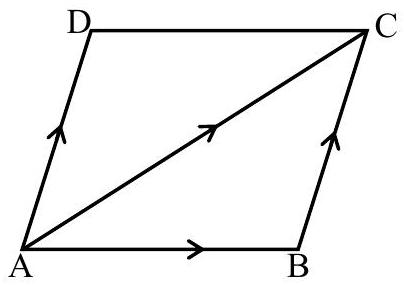
$\Rightarrow\left|\frac{3+6+\lambda-5}{\sqrt{9+36+(\lambda-5)^{2}}}\right|=1$
$\Rightarrow|\lambda+4|^{2}=\sqrt{\lambda^{2}-10 \lambda+70} \Rightarrow \lambda^{2}+16+8 \lambda=\lambda^{2}-10 \lambda+70$
$\Rightarrow 18 \lambda=54 \Rightarrow \lambda=3$
Now Quadratic Equation
$9 \mathrm{x}^{2}-18 \mathrm{x}+5=0 \Rightarrow 9 \mathrm{x}^{2}-3 \mathrm{x}-15 \mathrm{x}+5=0$
$\Rightarrow 3 \mathrm{x}(3 \mathrm{x}-1)-5(3 \mathrm{x}-1)=0 \Rightarrow(3 \mathrm{x}-1)(3 \mathrm{x}-5)=0$
$\Rightarrow \mathrm{x}=\frac{1}{3}, \frac{5}{3} \therefore \alpha=\frac{5}{3}, \beta=\frac{1}{3}$
$2 \alpha-\beta=\frac{10}{3}-\frac{1}{3}=\frac{9}{3}=3 \operatorname{Answer}(3)$Solution
$\cos \mathrm{C}=\frac{\mathrm{a}^{2}+\mathrm{b}^{2}-\mathrm{c}^{2}}{2 \mathrm{ab}}$
$\Rightarrow \cos (\pi-\theta)=\frac{|\overrightarrow{\mathrm{p}}|^{2}+|\overrightarrow{\mathrm{q}}|^{2}-|\overrightarrow{\mathrm{r}}|^{2}}{2|\overrightarrow{\mathrm{p}}||\overrightarrow{\mathrm{q}}|}$
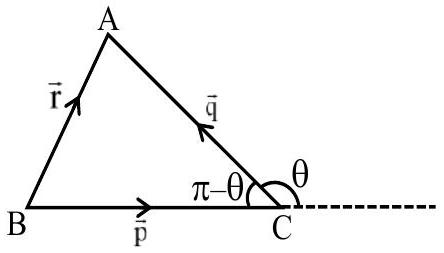
$\Rightarrow-\cos \theta=-\frac{1}{\sqrt{3}}=\frac{12+4-|\overrightarrow{\mathrm{r}}|^{2}}{2(2 \sqrt{3})(2)} \Rightarrow-8=16-|\overrightarrow{\mathrm{r}}|^{2}$
$\Rightarrow|\overrightarrow{\mathrm{r}}|^{2}=24$
$\Delta$ Rule $\overrightarrow{\mathrm{p}}+\overrightarrow{\mathrm{q}}-\overrightarrow{\mathrm{r}}=0 \Rightarrow \overrightarrow{\mathrm{r}}=\overrightarrow{\mathrm{p}}+\overrightarrow{\mathrm{q}}$
Now
$|\vec{p} \times(\vec{q}-3 \vec{r})|^{2}+3|\vec{r}|^{2}=\mid \vec{p} \times\left(\vec{q}-\left.3(\vec{p}+\vec{q})\right|^{2}+3(24)\right.$
$=|\vec{p} \times(-3 \vec{p}-2 \vec{q})|^{2}+72=|-3 \vec{p} \times \vec{p}-2 \vec{p} \times \vec{q}|^{2}+72$
$=|0-2 \vec{p} \times \vec{q}|^{2}+72=4|\vec{p}|^{2}|\vec{q}|^{2} \sin ^{2} \theta+72$
$=4(2 \sqrt{3})^{2}(2)^{2}\left(1-\cos ^{2} \theta\right)+72=4(12)(4)\left(1-\frac{1}{3}\right)+72$
$=128+72=200$ Answer(4)Solution
$\overrightarrow{\mathrm{c}} \times(2 \hat{\mathrm{i}}+3 \hat{\mathrm{j}}+4 \hat{\mathrm{k}})=-\overrightarrow{\mathrm{d}} \times(2 \hat{\mathrm{i}}+3 \hat{\mathrm{j}}+4 \hat{\mathrm{k}})$
$\Rightarrow(\overrightarrow{\mathrm{c}}+\overrightarrow{\mathrm{d}}) \times(2 \hat{\mathrm{i}}+3 \hat{\mathrm{j}}+4 \hat{\mathrm{k}})=0$
$\therefore \overrightarrow{\mathrm{c}}+\overrightarrow{\mathrm{d}} \| 2 \hat{\mathrm{i}}+3 \hat{\mathrm{j}}+4 \hat{\mathrm{k}}$
$\overrightarrow{\mathrm{c}}+\overrightarrow{\mathrm{d}}=\mathrm{p}(2 \hat{\mathrm{i}}+3 \hat{\mathrm{j}}+4 \hat{\mathrm{k}})$
$|\overrightarrow{\mathrm{c}}+\overrightarrow{\mathrm{d}}|=|\mathrm{p}| \sqrt{4+9+16}=\sqrt{29}$
$\Rightarrow|\mathrm{p}|=1 \Rightarrow \mathrm{p}= \pm 1$
$(\hat{\mathrm{c}}+\hat{\mathrm{d}}) \cdot(-7 \hat{\mathrm{i}}+2 \hat{\mathrm{j}}+3 \hat{\mathrm{k}})=\mathrm{p}(2 \hat{\mathrm{i}}+3 \hat{\mathrm{j}}+4 \hat{\mathrm{k}}) \cdot(-7 \hat{\mathrm{i}}+2 \hat{\mathrm{j}}+3 \hat{\mathrm{k}})$
$=\mathrm{p}[-14+6+12]=4 \mathrm{p}$
when $\mathrm{p}=1, \lambda_{1}=4$
when $p=-1, \lambda_{2}=-4$
Now equation of circle
$k^{2} x^{2}+\left(k^{2}-5 k+4\right) x y+(3 k-2) y^{2}-8 x+12 y-4=0$
coefficient of $\mathrm{xy}=0 \Rightarrow \mathrm{k}^{2}-5 \mathrm{k}+4=0$
$\Rightarrow(\mathrm{k}-1)(\mathrm{k}-4)=0 \Rightarrow \mathrm{k}=1,4$
coefficient of $\mathrm{x}^{2}=$ coefficient of $\mathrm{y}^{2}$
$\Rightarrow \mathrm{k}^{2}=3 \mathrm{k}-2 \Rightarrow \mathrm{k}^{2}-3 \mathrm{k}+2=0$
$\Rightarrow(\mathrm{k}-1)(\mathrm{k}-2)=0 \Rightarrow \mathrm{k}=1,2 \ldots(2)$
(1) $\cap(2)$
$\mathrm{k}=1$ only Answer(2)Solution
\[ \begin{aligned} & \text { let } \overrightarrow{\mathrm{c}}=x \hat{\mathrm{i}}+y \hat{\mathrm{j}}+z \hat{\mathrm{k}} \\ & \overrightarrow{\mathrm{c}} \cdot(\hat{\mathrm{i}}+\hat{\mathrm{j}}+\hat{\mathrm{k}})=x+y+z=4 \\ & \overrightarrow{\mathrm{~b}}=\overrightarrow{\mathrm{a}} \times \overrightarrow{\mathrm{c}}=\left|\begin{array}{ccc} \hat{\mathrm{i}} & \hat{\mathrm{j}} & \hat{\mathrm{k}} \\ -1 & 2 & 2 \\ x & y & z \end{array}\right| \\ & \Rightarrow 8 \hat{\mathrm{i}}+7 \hat{\mathrm{j}}-3 \hat{\mathrm{k}}=2(z-y) \hat{\mathrm{i}}-(-z-2 x) \hat{\mathrm{j}}+ \\ & z-y=4 \Rightarrow y=z-4 \\ & 2 x+z=7 \Rightarrow x=\frac{7-z}{2} ; 2 x+y=3 \\ & \text { From }(1) x+y+z=4 \Rightarrow \frac{7-z}{2}+z-4+ \\ & \Rightarrow 7-z+4 z-8=8 \Rightarrow 3 z=9 \Rightarrow z=3 \\ & x=\frac{7-z}{2}=2 ; y=z-4=-1 \\ & \overrightarrow{\mathrm{c}}=2 \hat{\mathrm{i}}-\hat{\mathrm{j}}+3 \hat{\mathrm{k}} \\ & \overrightarrow{\mathrm{a}}+\overrightarrow{\mathrm{c}}=(-\hat{\mathrm{i}}+2 \hat{\mathrm{j}}+2 \hat{\mathrm{k}})+(2 \hat{\mathrm{i}}-\hat{\mathrm{j}}+3 \hat{\mathrm{k}}) \\ & \overrightarrow{\mathrm{a}}+\overrightarrow{\mathrm{c}}=\hat{\mathrm{i}}+\hat{\mathrm{j}}+5 \hat{\mathrm{k}} \\ & |\overrightarrow{\mathrm{a}}+\overrightarrow{\mathrm{c}}|^{2}=1+1+25=27 \text { Answer }(4) \end{aligned} \] -
AuthorPosts
