- This topic has 1 reply, 1 voice, and was last updated 3 months, 1 week ago by
.
- You must be logged in to reply to this topic.
 shahkb4.
For a triangle ABC , let $\overrightarrow{\mathrm{p}}=\overrightarrow{\mathrm{BC}}, \overrightarrow{\mathrm{q}}=\overrightarrow{\mathrm{CA}}$ and $\overrightarrow{\mathrm{r}}=\overrightarrow{\mathrm{BA}}$.
If $|\overrightarrow{\mathrm{p}}|=2 \sqrt{3},|\overrightarrow{\mathrm{q}}|=2$ and $\cos \theta=\frac{1}{\sqrt{3}}$, where $\theta$ is the angle between $\vec{p}$ and $\vec{q}$, then $|\vec{p} \times(\vec{q}-3 \vec{r})|^{2}+3|\vec{r}|^{2}$ is equal to
[JEE MAIN 21 Jan 2026 S II]
(1) 340
(2) 220
(3) 410
(4) 200
$\cos \mathrm{C}=\frac{\mathrm{a}^{2}+\mathrm{b}^{2}-\mathrm{c}^{2}}{2 \mathrm{ab}}$
$\Rightarrow \cos (\pi-\theta)=\frac{|\overrightarrow{\mathrm{p}}|^{2}+|\overrightarrow{\mathrm{q}}|^{2}-|\overrightarrow{\mathrm{r}}|^{2}}{2|\overrightarrow{\mathrm{p}}||\overrightarrow{\mathrm{q}}|}$
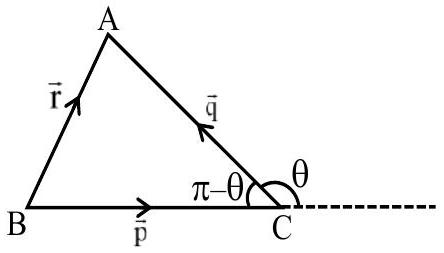
$\Rightarrow-\cos \theta=-\frac{1}{\sqrt{3}}=\frac{12+4-|\overrightarrow{\mathrm{r}}|^{2}}{2(2 \sqrt{3})(2)} \Rightarrow-8=16-|\overrightarrow{\mathrm{r}}|^{2}$
$\Rightarrow|\overrightarrow{\mathrm{r}}|^{2}=24$
$\Delta$ Rule $\overrightarrow{\mathrm{p}}+\overrightarrow{\mathrm{q}}-\overrightarrow{\mathrm{r}}=0 \Rightarrow \overrightarrow{\mathrm{r}}=\overrightarrow{\mathrm{p}}+\overrightarrow{\mathrm{q}}$
Now
$|\vec{p} \times(\vec{q}-3 \vec{r})|^{2}+3|\vec{r}|^{2}=\mid \vec{p} \times\left(\vec{q}-\left.3(\vec{p}+\vec{q})\right|^{2}+3(24)\right.$
$=|\vec{p} \times(-3 \vec{p}-2 \vec{q})|^{2}+72=|-3 \vec{p} \times \vec{p}-2 \vec{p} \times \vec{q}|^{2}+72$
$=|0-2 \vec{p} \times \vec{q}|^{2}+72=4|\vec{p}|^{2}|\vec{q}|^{2} \sin ^{2} \theta+72$
$=4(2 \sqrt{3})^{2}(2)^{2}\left(1-\cos ^{2} \theta\right)+72=4(12)(4)\left(1-\frac{1}{3}\right)+72$
$=128+72=200$ Answer(4)