
Question 1
- This topic has 0 replies, 1 voice, and was last updated 1 month, 2 weeks ago by
shahkb4.
-
AuthorPosts
-
22 September, 2026 at 12:42 am #11583
shahkb4
KeymasterP\#1 (JEE-Main 02 April, 2026 Morning shift) Solutions by OM Sharma sir
[CHAPTER M04 QUADRATIC EQUATION TOPIC T1 ]
\begin{itemize}
\item[1.] Let $\alpha, \alpha+2, \alpha \in \mathrm{Z}$, be the roots of the quadratic equation $\mathrm{x}(\mathrm{x}+2)+(\mathrm{x}+1)(\mathrm{x}+3)+(\mathrm{x}+2)(\mathrm{x}+4)+\ldots . .+(\mathrm{x}+\mathrm{n}-1)(\mathrm{x}+\mathrm{n}+1)=4 \mathrm{n}$ for some $\mathrm{n} \in \mathrm{N}$. Then ( $\mathrm{n}+\alpha$ ) is equal to [JEE MAIN 02 April 2026 S I]
(1) 0
(2) 1
(3) 2
(4) 3
\end{itemize}Ans.(3)
\begin{itemize}
\item[] Sol. $n x^{2}+x(2+4+6+\ldots . .+2 n)+(1.3+2.4 \ldots . .+(n-1)(n+1))=4 n$\[ \begin{aligned} & \therefore 1.3+2.4+\cdots .+(n-1)(n+1) \\ & \quad=\sum_{r=1}^{n-1} r(r+2)=\sum_{r=1}^{n-1} r^{2}+\sum_{r=1}^{n-1} 2 r=\frac{(n-1)(n)(2 n-1)}{6}+\frac{2(n-1) n}{2}=\frac{n(n-1)(2 n+5)}{6} \\ & \Rightarrow n x^{2}+n(n+1) x+\frac{n(n-1)(2 n+5)}{6}=4 n \Rightarrow x^{2}+(n+1) x+\frac{(n-1)(2 n+5)}{6}=4 \end{aligned} \]As roots are integers
D must be a perfect square $\mathrm{D}=(n+1)^{2}-4\left[\frac{(\mathrm{n}-1)(2 \mathrm{n}+5)}{6}-4\right]=16+\frac{13-\mathrm{n}^{2}}{3}$\[ \begin{aligned} & =20-\left(\frac{n^{2}-1}{3}\right)=P^{2} ; P \in I ; P \in\{1,2,3,4\} \\ & \Rightarrow n^{2}=61-3 P^{2} \text { For integer, } P=2, n=7 \\ & x^{2}+8 x+15=0 \Rightarrow x=-3,-5 \Rightarrow \alpha=-5, \alpha+2=-3 \therefore \alpha+n=7-5=2 \end{aligned} \]\end{itemize}
[CHAPTER M06 COMPLEX NUMBER TOPIC T1 ]
\begin{itemize}
\item[2.] Let x and y be real number such that $50\left(\frac{2 \mathrm{x}}{1+3 \mathrm{i}}-\frac{\mathrm{y}}{1-2 \mathrm{i}}\right)=31+17 \mathrm{i}, \mathrm{i}=\sqrt{-1}$. Then the value of $10(\mathrm{x}-3 \mathrm{y})$ is
[JEE MAIN 02 April 2026 S I]
(1) 20
(2) 31
(3) 35
(4) 75
\end{itemize}Ans.(4)
\begin{itemize}
\item[] Sol. $\quad 50\left(\frac{2 \mathrm{x}(1-3 \mathrm{i})}{10}-\frac{\mathrm{y}(1+2 \mathrm{i})}{5}\right)=31+17 \mathrm{i} \Rightarrow 10 \mathrm{x}-(30 \mathrm{x}) \mathrm{i}-10 \mathrm{y}-20 \mathrm{yi}=31+17 \mathrm{i}$\[ 10(x-y)=31 \quad \ldots(1) \text { and }-30 x-20 y=17 \]\[ \text { Eq.(1) } \times 3+\text { Eq.(2) } \]\[ \begin{aligned} & \Rightarrow 30 x-30 y-30 x-20 y=93+17 \\ & \Rightarrow y=-\frac{110}{50}=-2.2, x=0.9 \\ & \therefore 10(x-3 y)=75 \end{aligned} \]\end{itemize}
[CHAPTER M25 DETERMINANT TOPIC T2 ]
\begin{itemize}
\item[3.] Let $\alpha, \beta \in R$ be such that the system of linear equations $\mathrm{x}+2 \mathrm{y}+\mathrm{z}=5,2 \mathrm{x}+\mathrm{y}+\alpha \mathrm{z}=5,8 \mathrm{x}+4 \mathrm{y}+\beta \mathrm{z}=18$ has no22 September, 2026 at 12:42 am #11586KeymasterSolution
Then $\frac{\beta}{\alpha}$ is equal to [JEE MAIN 02 April 2026 S I]
(1) -4
(2) 4
(3) 8
(4) -8
\end{itemize}Ans.(2)
\begin{itemize}
\item[] Sol. for no solution $\Delta=\left|\begin{array}{lll}1 & 2 & 1 \\ 2 & 1 & \alpha \\ 8 & 4 & \beta\end{array}\right|=4 \alpha-\beta=0 \Rightarrow \beta=4 \alpha$
Second eq. $2 x+y+\alpha z=5$
third eq. $8 x+4 y+4 \alpha z=18 \Rightarrow 2 x+y+\alpha z=\frac{9}{2}$ both are parallel planes $\therefore$ no solution
\end{itemize}
[CHAPTER M26 MATRICES TOPIC T2 ]
\begin{itemize}
\item[4.] Let $\mathrm{A}=\left[\begin{array}{ll}1 & 2 \\ 1 & \alpha\end{array}\right]$ and $\mathrm{B}=\left[\begin{array}{ll}3 & 3 \\ \beta & 2\end{array}\right]$. If $\mathrm{A}^{2}-4 \mathrm{~A}+\mathrm{I}=0$ and $\mathrm{B}^{2}-5 \mathrm{~B}-6 \mathrm{I}=0$, then among the two statements
$(\mathrm{S} 1):[(\mathrm{B}-\mathrm{A})(\mathrm{B}+\mathrm{A})]^{\mathrm{T}}=\left[\begin{array}{rr}13 & 15 \\ 7 & 10\end{array}\right]$ and
$(\mathrm{S} 2): \operatorname{det}(\operatorname{adj}(\mathrm{A}+\mathrm{B}))=-5$,
[JEE MAIN 02 April 2026 S I]
(1) only (S1) is correct
(2) only (S2) is correct
(3) both (S1) and (S2) are correct
(4) both (S1) and (S2) are wrong
\end{itemize}Ans.(2)
\begin{itemize}
\item[] Sol. For 2 × 2 order matrix M
$\mathrm{M}^{2}-\operatorname{tr}(\mathrm{M}) \mathrm{M}+\operatorname{det}(\mathrm{M}) \mathrm{I}=0$
$\mathrm{A}=\left[\begin{array}{ll}1 & 2 \\ 1 & \alpha\end{array}\right] \Rightarrow \mathrm{A}^{2}-4 \mathrm{~A}+\mathrm{I}=0$; trace of matrix $\alpha+1=4 \Rightarrow \alpha=3$
$B=\left[\begin{array}{ll}3 & 3 \\ \beta & 2\end{array}\right] \Rightarrow B^{2}-5 B-6 I=0 ; \operatorname{det} .(B)=6-3 \beta=-6 \Rightarrow 3 \beta=12 \Rightarrow \beta=4$
$\mathrm{B}-\mathrm{A}=\left[\begin{array}{cc}2 & 1 \\ 3 & -1\end{array}\right] ; \mathrm{B}+\mathrm{A}=\left[\begin{array}{ll}4 & 5 \\ 5 & 5\end{array}\right] \Rightarrow \operatorname{adj}(\mathrm{A}+\mathrm{B})=\left[\begin{array}{cc}5 & -5 \\ -5 & 4\end{array}\right]$
$(\mathrm{B}-\mathrm{A})(\mathrm{B}+\mathrm{A})=\left[\begin{array}{cc}13 & 15 \\ 7 & 10\end{array}\right]$
\end{itemize}
[CHAPTER M05 PROGRESSION TOPIC T1 ]
\begin{itemize}
\item[5.] Let A be the set of first 101 terms of an A.P., whose first term is 1 and the common difference is 5 and let B be the set of first 71 terms of an A.P., whose first term is 9 and the common difference is 7 . Then the number of elements is $\mathrm{A} \cap \mathrm{B}$, which are divisible by 3 , is
[JEE MAIN 02 April 2026 S I]
(1) 4
(2) 5
(3) 6
(4) 7
\end{itemize}Ans.(2)
\begin{itemize}
\item[] Sol. $\quad \mathrm{AP}_{1}$ Set $\mathrm{A}=\{1,6,11,16 \ldots \ldots \ldots .\},. \mathrm{n}(\mathrm{A})=101$
$\mathrm{T}_{101}^{\mathrm{A}}=1+100 \times 5=501$
$\mathrm{AP}_{2}$ Set $\mathrm{B}=\{9,16 \ldots \ldots \ldots .\} .\mathrm{N}(\mathrm{B})=71$
$\mathrm{T}_{71}^{\mathrm{B}}=9+70 \times 7=499$
Common A.P., common difference $\mathrm{D}=\mathrm{L} . \mathrm{C} . \mathrm{M}\left\{\mathrm{d}_{1}, \mathrm{~d}_{2}\right\}=35$;
$1^{\text {st }}$ Common term is 16
$16+(\mathrm{n}-1) 35 \leq 499 \Rightarrow \mathrm{n} \leq 14.8 \Rightarrow \mathrm{n}=14$
$\mathrm{T}_{\mathrm{n}}^{\mathrm{AnB}}=16+(\mathrm{n}-1) 35=35 \mathrm{n}-19$ is divisible by 3
$=3(11 n-6)+2 n-1$ is divisible by 3
$2 \mathrm{n}-1$ must be divisible by 3
$\mathrm{n} \in\{2,5,8,11,14\} \therefore 5$ such terms
\end{itemize}
[CHAPTER M08 PERMUTATION \& COMBINATION TOPIC T3 ]
\begin{itemize}
\item[6.] The number of seven-digit numbers, that can be formed by using the digits 1,2,3,5 and 7 such that each digit is used at least once, is
[JEE MAIN 02 April 2026 S I]
(1) 15400
(2) 17800
(3) 16800
(4) 29400
\end{itemize}Ans.(3)
Sol. Case I: Exactly one digit repeated thrice $\rightarrow^{5} C_{1} \times \frac{7!}{3!}=4200$
Case II: Exactly two digits repeated twice → ${ }^{5} \mathrm{C}_{2} \times \frac{7!}{2!2!}=12600$
Total such numbers $=16800$
[CHAPTER M07 BINOMIAL THEOREM TOPIC T3]
\begin{itemize}
\item[7.] The number of elements in the set $\mathrm{S}=\left\{(\mathrm{r}, \mathrm{k}): \mathrm{k} \in \mathrm{Z}\right.$ and $\left.{ }^{36} \mathrm{C}_{\mathrm{r}+1}=\frac{6\left({ }^{35} \mathrm{C}_{\mathrm{r}}\right)}{\left(\mathrm{k}^{2}-3\right)}\right\}$, is
[JEE MAIN 02 April 2026 S I]
(1) 2
(2) 4
(3) 8
(4) 16
\end{itemize}Ans.(2)
\begin{itemize}
\item[] Sol. $\quad \frac{36}{\mathrm{r}+1} .{ }^{35} \mathrm{C}_{\mathrm{r}}=6 . \frac{{ }^{35} \mathrm{C}_{\mathrm{r}}}{\mathrm{k}^{2}-3} \Rightarrow \mathrm{k}^{2}-3=\frac{\mathrm{r}+1}{6} \Rightarrow \mathrm{k}^{2}=\frac{\mathrm{r}+19}{6}=$ Perfect square
$\because 0 \leq \mathrm{r} \leq 35 \Rightarrow 19 \leq \mathrm{r}+19 \leq 54 \Rightarrow 3.1 \leq \frac{\mathrm{r}+19}{6} \leq 9$
$\therefore \mathrm{k}^{2}=4,9 \Rightarrow \mathrm{k}= \pm 2, \pm 3 \therefore(\mathrm{r}, \mathrm{k}) \Rightarrow(5, \pm 2)$ or $(35, \pm 3) \therefore 4$ such pairs
\end{itemize}
[CHAPTER M09 STATISTICS TOPIC T1 ]
8. If the mean of the data is 21, then k is one of the roots of the equation[t]{|l|l|l|l|l|l|l|}
Class5-10 10-15 15-20 20-25 25-30 30-35 Frequency 2 k 28 54 $\mathrm{k}+1$ 5 [JEE MAIN 02 April 2026 S I]
(1) $2 x^{2}-23 x-10=0$
(2) $4 \mathrm{x}^{2}-35 \mathrm{x}+24=0$
(3) $2 \mathrm{x}^{2}-19 \mathrm{x}-10=0$
(4) $2 \mathrm{x}^{2}-35 \mathrm{x}+98=0$Ans.(3)
Sol.
[t]{|l|l|l|l|l|l|l|}
Class5-10 10-15 15-20 20-25 25-30 30-35 $\mathrm{x}_{\mathrm{i}}$ 7.5 12.5 17.5 22.5 27.5 32.5 Frequency 2 k 28 54 $\mathrm{k}+1$ 5 Mean $=21=\frac{15+12.5 \mathrm{k}+490+1215+27.5+27.5 \mathrm{k}+162.5}{90+2 \mathrm{k}}$
$\Rightarrow 1890+42 \mathrm{k}=1910+40 \mathrm{k} \Rightarrow \mathrm{k}=10$[CHAPTER M10 CARTESIAN SYSTEM \& STRAIGHT LINE TOPIC T1 ]
9. Let the mid points of the sides of a triangle ABC be $\left(\frac{5}{2}, 7\right),\left(\frac{5}{2}, 3\right)$ and (4,5). If its incentre is $(\mathrm{h}, \mathrm{k})$, then $3 \mathrm{~h}+\mathrm{k}$ is equal to
[JEE MAIN 02 April 2026 S I]
(1) 11
(2) 12
(3) 13
(4) 14Ans.(3)
Sol. $\quad \mathrm{D}\left(\frac{\mathrm{x}_{1}+\mathrm{x}_{2}}{2}, \frac{\mathrm{y}_{1}+\mathrm{y}_{2}}{2}\right) \equiv\left(\frac{5}{2}, 7\right)$
$\Rightarrow \mathrm{x}_{1}+\mathrm{x}_{2}=5 ; \mathrm{y}_{1}+\mathrm{y}_{2}=14$
$\mathrm{E}\left(\frac{\mathrm{x}_{2}+\mathrm{x}_{3}}{2}, \frac{\mathrm{y}_{2}+\mathrm{y}_{3}}{2}\right) \equiv\left(\frac{5}{2}, 3\right)$
$\Rightarrow \mathrm{x}_{2}+\mathrm{x}_{3}=5, \mathrm{y}_{2}+\mathrm{y}_{3}=6$
Centroid of ABC = Centroid of DEF\[ \begin{aligned} & \left(\frac{x_{1}+x_{2}+x_{3}}{3}, \frac{y_{1}+y_{2}+y_{3}}{3}\right) \equiv\left(\frac{\frac{5}{2}+\frac{5}{2}+4}{3}, \frac{7+3+5}{3}\right) \\ & \Rightarrow x_{1}+x_{2}+x_{3}=9 ; y_{1}+y_{2}+y_{3}=15 \end{aligned} \]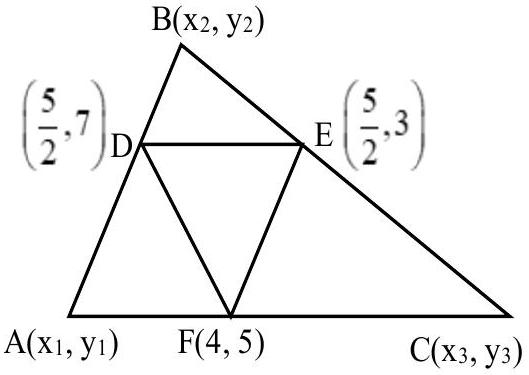
We have $\mathrm{x}_{1}=4, \mathrm{x}_{2}=1, \mathrm{x}_{3}=4 ; \mathrm{y}_{1}=9, \mathrm{y}_{2}=5, \mathrm{y}_{3}=1$\[ \begin{aligned} & A(4,9), B(1,5), C(4,1) \\ & A=B C=5, b=8, c=5 \\ & I\left(\frac{a_{1}+b x_{2}+c x_{3}}{a+b+c}, \frac{a y_{1}+b y_{2}+c y_{3}}{a+b+c}\right)=\left(\frac{20+8+20}{5+8+5}, \frac{45+40+5}{5+8+5}\right) \equiv I\left(\frac{8}{3}, 5\right)=(h, k) \\ & \therefore 3 h+k=8+5=13 \end{aligned} \][CHAPTER M13 ELLIPSE TOPIC T1 ]
10. Let an ellipse $\frac{x^{2}}{a^{2}}+\frac{y^{2}}{b^{2}}=1, a[CHAPTER M02 TRIGONOMETRY TOPIC T1 ]
11. If $\sin \left(\frac{\pi}{18}\right) \sin \left(\frac{5 \pi}{18}\right) \sin \left(\frac{7 \pi}{18}\right)=\mathrm{K}$, then the value of $\sin \left(\frac{10 \mathrm{~K} \pi}{3}\right)$ is
[JEE MAIN 02 April 2026 S I]
(1) $\frac{\sqrt{3}+1}{2 \sqrt{2}}$
(2) $\frac{\sqrt{3}-1}{\sqrt{2}}$
(3) $\frac{\sqrt{3}}{2}$
(4) $\frac{1}{2}$Ans.(1)
Sol. $\because \sin \theta \sin \left(60^{\circ}-\theta\right) \sin \left(60^{\circ}+\theta\right)=\frac{1}{4} \sin 3 \theta$
put $\theta=10^{\mathrm{o}} ; \mathrm{K}=\sin 10^{\mathrm{o}} \sin 50^{\mathrm{o}} \sin 70^{\mathrm{o}}=\frac{1}{4} \sin 30^{\mathrm{o}}=\frac{1}{8}$
$\sin \left(\frac{10 \mathrm{~K} \pi}{3}\right)=\sin \left(10 \times \frac{1}{8} \cdot \frac{\pi}{3}\right)=\sin \frac{5 \pi}{12}=\sin \left(45^{\circ}+30^{\circ}\right)=\sin 45^{\circ} \cos 30^{\circ}+\cos 45^{\circ} \sin 30^{\circ}=\frac{\sqrt{3}+1}{2 \sqrt{2}}$
[CHAPTER M02 TRIGONOMETRY TOPIC T2 ]
\begin{itemize}
\item[12.] Let $\mathrm{S}=\{\mathrm{x} \in[-\pi, \pi]: \sin \mathrm{x}(\sin \mathrm{x}+\cos \mathrm{x})=\mathrm{a}, \mathrm{a} \in \mathrm{Z}\}$. Then $\mathrm{n}(\mathrm{S})$ is equal to
[JEE MAIN 02 April 2026 S I]
(1) 3
(2) 6
(3) 7
(4) 9
\end{itemize}Ans.(4)
\begin{itemize}
\item[] Sol. $\quad \sin x(\sin x+\cos x)=\sin ^{2} x+\sin x \cos x$\[ =\frac{1-\cos 2 x}{2}+\frac{\sin 2 x}{2}=\frac{1+\sin 2 x-\cos 2 x}{2} \in\left[\frac{1-\sqrt{2}}{2}, \frac{1+\sqrt{2}}{2}\right] \]2 integers are possible $\Rightarrow \mathrm{a}=0,1$
If $\mathrm{a}=0 ; \sin \mathrm{x}(\sin \mathrm{x}+\cos \mathrm{x})=0$
Case I: $\sin \mathrm{x}=0 \Rightarrow \mathrm{x}=-\pi, 0, \pi$; (3 solutions)
Case II: $\sin \mathrm{x}+\cos \mathrm{x}=0 \Rightarrow \tan \mathrm{x}=-1 \Rightarrow \mathrm{x}=-\frac{\pi}{4}, \frac{3 \pi}{4}$ (2 solutions)
If $\mathrm{a}=1 ; \sin \mathrm{x}(\sin \mathrm{x}+\cos \mathrm{x})=1 \Rightarrow \sin ^{2} \mathrm{x}+\sin \mathrm{x} \cos \mathrm{x}=1 \Rightarrow \sin \mathrm{x} \cos \mathrm{x}=1-\sin ^{2} \mathrm{x}=\cos ^{2} \mathrm{x}$\[ \Rightarrow(\sin \mathrm{x}-\cos \mathrm{x}) \cos \mathrm{x}=0 \]Case III: $\sin \mathrm{x}-\cos \mathrm{x}=0 \Rightarrow \tan \mathrm{x}=1 \Rightarrow \mathrm{x}=-\frac{3 \pi}{4}, \frac{\pi}{4}$ (2 solutions)
Case IV: $\cos \mathrm{x}=0 \Rightarrow \mathrm{x}= \pm \frac{\pi}{2}$ (2 solutions)
Total 9 solution
\end{itemize}
[CHAPTER M28 3D-GEOMETRY TOPIC T2 ]
\begin{itemize}
\item[13.] If the point of intersection of the lines $\frac{\mathrm{x}+1}{3}=\frac{\mathrm{y}+\mathrm{a}}{5}=\frac{\mathrm{z}+\mathrm{b}+1}{7}$ and $\frac{\mathrm{x}-2}{1}=\frac{\mathrm{y}-\mathrm{b}}{4}=\frac{\mathrm{z}-2 \mathrm{a}}{7}$ lies on xy-plane, then the value of a + b is
[JEE MAIN 02 April 2026 S I]
(1) 2
(2) 5
(3) 7
(4) 9
\end{itemize}Ans.(3)
\begin{itemize}
\item[] Sol. As both line intersects on xy plane
Put $\mathrm{z}=0, \frac{\mathrm{x}+1}{3}=\frac{\mathrm{y}+\mathrm{a}}{5}=\frac{\mathrm{b}+1}{7} \& \frac{\mathrm{x}-2}{1}=\frac{\mathrm{y}-\mathrm{b}}{4}=-\frac{2 \mathrm{a}}{7}$\[ \begin{array}{l|c} \Rightarrow x=\frac{3 b+3}{7}-1=\frac{3 b-4}{7} & x=2-\frac{2 a}{7} \\ \Rightarrow y=\frac{5 b+5}{7}-a=\frac{5 b+5-7 a}{7} & y=b-\frac{8 a}{7} \\ X=\frac{3 b-4}{7}=2-\frac{2 a}{7} & y=\frac{5 b+5-7 a}{7}=\frac{7 b-8 a}{7} \\ \Rightarrow 3 b-4=14-2 a & \Rightarrow 5 b+5-7 a=7 b-8 a \\ \Rightarrow 2 a+3 b=18 \ldots(1) & \Rightarrow a=2 b-5 \ldots .(2) \end{array} \]\end{itemize}
[CHAPTER M27 VECTOR ALGEBRA TOPIC T1 ]
\begin{itemize}
\item[14.] If $\vec{a}$ and $\vec{b}$ are two vectors such that $|\vec{a}|=2$ and $|\vec{b}|=3$, then the maximum value of $3|(3 \vec{a}+2 \vec{b})|+4|(3 \vec{a}-2 \vec{b})|$ is
[JEE MAIN 02 April 2026 S I]
(1) 30
(2) 36
(3) 60
(4) 72
\end{itemize}Ans.(3)
\begin{itemize}
\item[] Sol. $E=3 \sqrt{9 a^{2}+4 b^{2}+12 \vec{a} \cdot \vec{b}}+4 \sqrt{9 a^{2}+4 b^{2}-12 \vec{a} \cdot \vec{b}}$\[ \begin{aligned} & =3 \sqrt{36+36+12 \times 6 \cos \theta}+4 \sqrt{36+36-72 \cos \theta}=3 \sqrt{72+72 \cos \theta}+4 \sqrt{72-72 \cos \theta} \\ & =18 \sqrt{2} \sqrt{1+\cos \theta}+24 \sqrt{2} \sqrt{1-\cos \theta} \\ & =18 \sqrt{2} \sqrt{2} \cos \frac{\theta}{2}+24 \sqrt{2}\left(\sqrt{2} \sin \frac{\theta}{2}\right)=36\left(\cos \frac{\theta}{2}\right)+48 \sin \left(\frac{\theta}{2}\right)=12\left[3 \cos \frac{\theta}{2}+4 \sin \frac{\theta}{2}\right] \\ & E_{\max }=12 \sqrt{3^{2}+4^{2}}=12 \times 5=60 \end{aligned} \]\end{itemize}
[CHAPTER M28 3D GEOMETRY TOPIC T2 ]
\begin{itemize}
\item[15.] Let a line L passing through the point $(1,1,1)$ be perpendicular to both the vectors $2 \hat{\mathrm{i}}+2 \hat{\mathrm{j}}+\hat{\mathrm{k}}$ and $\hat{\mathrm{i}}+2 \hat{\mathrm{j}}+2 \mathrm{k}$. If $\mathrm{P}(\mathrm{a}, \mathrm{b}, \mathrm{c})$ is the foot of perpendicular from the origin on the line L, then the value of $34(\mathrm{a}+\mathrm{b}+\mathrm{c})$ is
[JEE MAIN 02 April 2026 S I]
(1) 50
(2) 80
(3) 100
(4) 120
\end{itemize}
\begin{itemize}
\item[] Ans.(3) Direction vector of line is $=\left|\begin{array}{ccc}\hat{i} & \hat{j} & \hat{k} \\ 2 & 2 & 1 \\ 1 & 2 & 2\end{array}\right|=2 \hat{i}-3 \hat{j}+2 \hat{k}$
Equation of line is $\frac{\mathrm{x}-1}{2}=\frac{\mathrm{y}-1}{-3}=\frac{\mathrm{z}-1}{2}=\lambda$
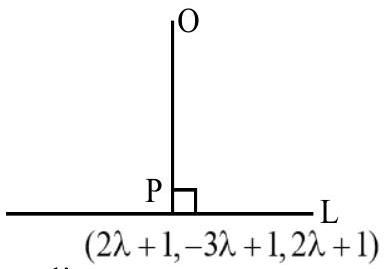
let $\mathrm{P}(2 \lambda+1,-3 \lambda+1,2 \lambda+1)$ be the foot of perpendicular from (0,0,0) upon given line
$\Rightarrow \overrightarrow{\mathrm{OP}} .(2 \hat{\mathrm{i}}-3 \hat{\mathrm{j}}+2 \mathrm{k})=0 \Rightarrow 2(2 \lambda+1)-3(-3 \lambda+1)+2(2 \lambda+1)=0 \Rightarrow \lambda=-\frac{1}{17}$
So $(\mathrm{a}, \mathrm{b}, \mathrm{c}) \equiv\left(-\frac{2}{17}+1, \frac{3}{17}+1,-\frac{2}{17}+1\right) \therefore 34(\mathrm{a}+\mathrm{b}+\mathrm{c})=100$
\end{itemize}[CHAPTER M18 LIMIT OF UNCTION TOPIC T2 ]
\begin{itemize}
\item[16.] If $\lim _{\mathrm{x} \rightarrow 2} \frac{\sin \left(\mathrm{x}^{3}-5 \mathrm{x}^{2}+\mathrm{ax}+\mathrm{b}\right)}{(\sqrt{\mathrm{x}-1}-1) \log _{\mathrm{e}}(\mathrm{x}-1)}=\mathrm{m}$, then $\mathrm{a}+\mathrm{b}+\mathrm{m}$ is equal to
[JEE MAIN 02 April 2026 S I]
(1) 5
(2) 6
(3) 8
(4) 10
\end{itemize}Ans.(2)
\begin{itemize}
\item[] Sol. $\quad \because$ Denominator $=0$ at $\mathrm{x}=2$
For finite limit existence, $\therefore$ Numerator $=0$ at $\mathrm{x}=2$\[ \Rightarrow 2^{3}-5(2)^{2}+\mathrm{a}(2)+\mathrm{b}=0 \Rightarrow 2 \mathrm{a}+\mathrm{b}=12 \]$\therefore \mathrm{m}=\lim _{\mathrm{x} \rightarrow 2} \frac{\frac{\sin \left(\mathrm{x}^{3}-5 \mathrm{x}^{2}+\mathrm{ax}+\mathrm{b}\right)}{\left(\mathrm{x}^{3}-5 \mathrm{x}^{2}+\mathrm{ax}+\mathrm{b}\right)} \cdot\left(\mathrm{x}^{3}-5 \mathrm{x}^{2}+\mathrm{ax}+\mathrm{b}\right)}{\left(\frac{\mathrm{x}-1-1}{\sqrt{\mathrm{x}-1}+1}\right) \cdot \frac{\log _{\mathrm{e}}(1+(\mathrm{x}-2))}{(\mathrm{x}-2)} \cdot(\mathrm{x}-2)} \Rightarrow \mathrm{m}=\lim _{\mathrm{x} \rightarrow 2} 2\left(\frac{\mathrm{x}^{3}-5 \mathrm{x}^{2}+\mathrm{ax}+\mathrm{b}}{(\mathrm{x}-2)^{2}}\right)$ using L-H rule
\[ \Rightarrow \mathrm{m}=\lim _{\mathrm{x} \rightarrow 2} 2\left(\frac{3 \mathrm{x}^{2}-10 \mathrm{x}+\mathrm{a}}{2(\mathrm{x}-2)}\right) \]∵ Denominator $=0$ at $\mathrm{x}=2, \therefore$ Numerator $=0$ at $\mathrm{x}=2$
$\Rightarrow 3(2)^{2}-10(2)+\mathrm{a}=0 \Rightarrow \mathrm{a}=8$, put $\mathrm{a}=8$, in (1), we get $\mathrm{b}=-4$
using L-H rule\[ \therefore \mathrm{m}=\lim _{\mathrm{x} \rightarrow 2} 2\left(\frac{6 \mathrm{x}-10}{2}\right)=2 \therefore \mathrm{a}+\mathrm{b}+\mathrm{m}=8-4+2=6 \]\end{itemize}
[CHAPTER M24 DIFFERENTIAL EQUATION TOPIC T1 ]
\begin{itemize}
\item[17.] If the curve $y=f(x)$ passes through the point (1,e) and satisfies the differential equation $d y=y\left(2+\log _{e} x\right) d x, x>0$, then $f(e)$ is equal to
[JEE MAIN 02 April 2026 S I]
(1) $\mathrm{e}^{\mathrm{e}}$
(2) $\mathrm{e}^{\mathrm{e}^{2}}$
(3) $\mathrm{e}^{2 \mathrm{e}}$
(4) $\mathrm{e}^{2^{\mathrm{e}}}$
\end{itemize}Ans.(3)
\begin{itemize}
\item[] Sol. $\frac{\mathrm{dy}}{\mathrm{dx}}=\mathrm{y}(2+\ell \mathrm{nx}) \Rightarrow \int \frac{\mathrm{dy}}{\mathrm{y}}=\int(2+\ell \mathrm{nx}) \mathrm{dx}=2 \mathrm{x}+\int \ell \mathrm{nxdx}$
$\ell \mathrm{ny}=2 \mathrm{x}+\mathrm{x} \ell \mathrm{nx}-\mathrm{x}+\mathrm{C} \Rightarrow \ell \mathrm{ny}=\mathrm{x}+\mathrm{x} \ell \mathrm{nx}+\mathrm{C}$
Since it passes through $(1, e) ; 1=1+0+C \Rightarrow C=0 \Rightarrow \ell n y=x+x \ell n x$\[ \Rightarrow f(x)=y=e^{x+x \ln x} \Rightarrow f(e)=e^{e+e}=e^{2 e} \]\end{itemize}
[CHAPTER M21 APPLICATION OF DERIVATIVE TOPIC T1 ]
\begin{itemize}
\item[18.] The number of critical points of the function $\mathrm{f}(\mathrm{x})=\left\{\begin{array}{cc}\left|\frac{\sin \mathrm{x}}{\mathrm{x}}\right|, & \mathrm{x} \neq 0 \\ 1, & \mathrm{x}=0\end{array}\right.$ in the interval $(-2 \pi, 2 \pi)$ is equal to
[JEE MAIN 02 April 2026 S I]
(1) 1
(2) 3
(3) 5
(4) 7
\end{itemize}Ans.(3)
\begin{itemize}
\item[] Sol. Critical points where $\mathrm{f}^{\prime}(\mathrm{x})$ does not exist or $\mathrm{f}^{\prime}(\mathrm{x})=0$
$\lim _{\mathrm{x} \rightarrow 0}\left|\frac{\sin \mathrm{x}}{\mathrm{x}}\right|=1=\mathrm{f}(0) \therefore \mathrm{f}(\mathrm{x})$ is continuous in $\mathrm{x} \in(-2 \pi, 2 \pi)$
Now $\frac{\mathrm{d}}{\mathrm{dx}}\left(\frac{\sin \mathrm{x}}{\mathrm{x}}\right)=\frac{\mathrm{x} \cos \mathrm{x}-\sin \mathrm{x}}{\mathrm{x}^{2}}$
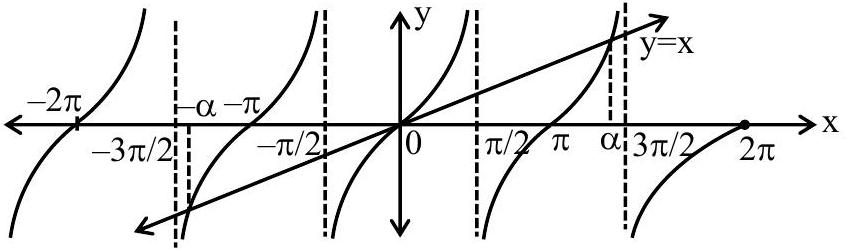 \[ \Rightarrow \mathrm{f}^{\prime}(\mathrm{x})=0 \Rightarrow \tan \mathrm{x}=\mathrm{x} \Rightarrow \mathrm{x}= \pm \alpha, 0 \]
\end{itemize}
\begin{itemize}
\item[] we get 3 solution in $(-2 \pi, 2 \pi)$
also $\mathrm{f}^{\prime}(\mathrm{x})$ does not exist at $\mathrm{x}=-\pi, 0, \pi$
hence total 5 points
\end{itemize}[CHAPTER M22 INTEGRATION TOPIC T2 ]
\begin{itemize}
\item[19.] Let $[\cdot]$ denote the greatest integer function. Then the value of $\int_{0}^{3}\left(\frac{\mathrm{e}^{\mathrm{x}}+\mathrm{e}^{-\mathrm{x}}}{[\mathrm{x}]!}\right) \mathrm{dx}$ is
[JEE MAIN 02 April 2026 S I]
(1) $\mathrm{e}^{2}+\mathrm{e}^{3}-\frac{1}{\mathrm{e}^{2}}-\frac{1}{\mathrm{e}^{3}}$
(2) $\frac{1}{2}\left(\mathrm{e}^{2}+\mathrm{e}^{3}-\frac{1}{\mathrm{e}^{2}}-\frac{1}{\mathrm{e}^{3}}\right)$
(3) $e^{2}+e^{3}-\frac{1}{2 e^{2}}-\frac{1}{2 e^{3}}$
(4) $\frac{1}{2}\left(\mathrm{e}^{2}+\mathrm{e}^{3}\right)-\frac{1}{\mathrm{e}^{2}}-\frac{1}{\mathrm{e}^{3}}$
\end{itemize}Ans.(2)
\begin{itemize}
\item[] Sol.\[ \begin{aligned} & \int_{0}^{1} \frac{e^{x}+e^{-x}}{1} d x+\int_{1}^{2} \frac{e^{x}+e^{-x}}{1} d x+\int_{2}^{3} \frac{e^{x}+e^{-x}}{2} d x=\int_{0}^{2} e^{x} d x+\int_{0}^{2} e^{-x} d x+\frac{1}{2} \int_{2}^{3}\left(e^{x}+e^{-x}\right) d x \\ & =\left(e^{2}-1\right)+\frac{\left(e^{-2}-1\right)}{-1}+\frac{1}{2}\left(\left(e^{3}-e^{2}\right)-\left(e^{-3}-e^{-2}\right)\right)=\frac{e^{3}+e^{2}-e^{-2}-e^{-3}}{2} \end{aligned} \]\end{itemize}
[CHAPTER M24 DIFFERENTIAL EQUATION TOPIC T1 ]
\begin{itemize}
\item[20.] Let $y=y(x)$ be the solution curve of the differential equation $(1+\sin x) \frac{d y}{d x}+(y+1) \cos x=0, y(0)=0$. If the curve $y=y(x)$ passes through the point $\left(\alpha,-\frac{1}{2}\right)$, then a value of $\alpha$ is
[JEE MAIN 02 April 2026 S I]
(1) $\frac{\pi}{6}$
(2) $\frac{\pi}{4}$
(3) $\frac{\pi}{3}$
(4) $\frac{\pi}{2}$
\end{itemize}Ans.(4)
\begin{itemize}
\item[] Sol.\[ \begin{aligned} & \int \frac{\mathrm{dy}}{\mathrm{y}+1}=-\int \frac{\cos \mathrm{x}}{1+\sin \mathrm{x}} \mathrm{dx} \Rightarrow \ln (\mathrm{y}+1)=-\ell \mathrm{n}(1+\sin \mathrm{x})+\ell \mathrm{nk} \\ & \Rightarrow \ln (\mathrm{y}+1)=\ln \left(\frac{\mathrm{k}}{1+\sin \mathrm{x}}\right) \Rightarrow \mathrm{y}+1=\frac{\mathrm{k}}{1+\sin \mathrm{x}} \\ & \because \mathrm{y}(0)=0 \Rightarrow \mathrm{k}=1 \\ & \Rightarrow \mathrm{y}+1=\frac{1}{1+\sin \mathrm{x}} \text { passes through }\left(\alpha,-\frac{1}{2}\right) \\ & -\frac{1}{2}+1=\frac{1}{1+\sin \alpha} \Rightarrow \sin \alpha=1 \Rightarrow \alpha=\frac{\pi}{2} \end{aligned} \]\end{itemize}
[CHAPTER M16 FUNCTION \& GRAPH TOPIC T1 ]
\begin{itemize}
\item[21.] If the domain of the function $\mathrm{f}(\mathrm{x})=\sqrt{\log _{(0.6)}\left(\left|\frac{2 \mathrm{x}-5}{\mathrm{x}^{2}-4}\right|\right)}$ is $(-\infty, \mathrm{a}] \cup\{\mathrm{b}\} \cup[\mathrm{c}, \mathrm{d}) \cup(\mathrm{e}, \infty)$, then the value of $\mathrm{a}+\mathrm{b}+\mathrm{c}+\mathrm{d}+\mathrm{e}$ is $\_\_\_\_$.
[JEE MAIN 02 April 2026 S I]
\end{itemize}Ans.(4)
\begin{itemize}
\item[] Sol. For domain $\log _{0.6}\left|\frac{2 \mathrm{x}-5}{\mathrm{x}^{2}-4}\right| \geq 0 \Rightarrow\left|\frac{2 \mathrm{x}-5}{\mathrm{x}^{2}-4}\right| \leq 1$ \& $\mathrm{x} \neq \frac{5}{2}$\[ \begin{aligned} & \Rightarrow|2 x-5| \leq\left|x^{2}-4\right| \Rightarrow(2 x-5)^{2} \leq\left(x^{2}-4\right)^{2} \\ & \Rightarrow\left(2 x-5+x^{2}-4\right)\left(2 x-5-x^{2}+4\right) \leq 0 \\ & \Rightarrow\left(x^{2}+2 x-9\right)\left(x^{2}-2 x+1\right) \geq 0 \\ & \Rightarrow(x+1-\sqrt{10})(x+1+\sqrt{10})(x-1)^{2} \geq 0 \\ & x \in(-\infty,-1-\sqrt{10}] \cup\{1\} \cup\left[-1+\sqrt{10}, \frac{5}{2}\right) \cup\left(\frac{5}{2}, \infty\right) \\ & \Rightarrow a+b+c+d+e=-2+1+5=4 \end{aligned} \]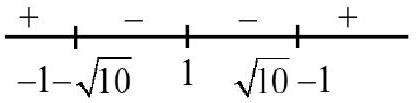
\end{itemize}[CHAPTER M05 PROGRESSION TOPIC T3]
\begin{itemize}
\item[22.] If $\sum_{\mathrm{k}=1}^{\mathrm{n}} \mathrm{a}_{\mathrm{k}}=6 \mathrm{n}^{3}$, then $\sum_{\mathrm{k}=1}^{6}\left(\frac{\mathrm{a}_{\mathrm{k}+1}-\mathrm{a}_{\mathrm{k}}}{36}\right)^{2}$ is equal to
[JEE MAIN 02 April 2026 S I]
\end{itemize}Ans.(91)
\begin{itemize}
\item[] Sol. $S_{n}=a_{1}+a_{2}+\ldots \ldots+a_{n}=6 n^{3}$\[ a_{n}=S_{n}-S_{n-1}=6 n^{3}-6(n+1)^{3} \]\end{itemize}
\[ \begin{aligned} & a_{n}=6 n^{3}-6\left[n^{3}-3 n^{2}+3 n-1\right] \\ & a_{n}=6\left[3 n^{2}-3 n+1\right] \\ & a_{n+1}=6\left[3(n+1)^{2}-3(n+1)+1\right] \\ & a_{n+1}-a_{n}=36 n \\ & \sum_{k=1}^{6}\left(\frac{a_{k+1}-a_{k}}{36}\right)^{2}=\sum_{k=1}^{6}\left(\frac{36 k}{36}\right)^{2}=\sum_{k=1}^{6} k^{2}=\frac{6 \times 7 \times 13}{6}=91 \end{aligned} \][CHAPTER M29 PROBABILITY TOPIC T1 ]
\begin{itemize}
\item[23.] Let $\mathrm{a}, \mathrm{b}, \mathrm{c} \in\{1,2,3,4\}$. If the probability, that $\mathrm{ax}^{2}+2 \sqrt{2} \mathrm{bx}+\mathrm{c}>0$ for all $\mathrm{x} \in \mathrm{R}$, is $\frac{\mathrm{m}}{\mathrm{n}}, \operatorname{gcd}(\mathrm{m}, \mathrm{n})=1$, then $\mathrm{m}+\mathrm{n}$ is equal to $\_\_\_\_$.
[JEE MAIN 02 April 2026 S I]
\end{itemize}Ans.(81)
\begin{itemize}
\item[] Sol. if $\mathrm{ax}^{2}+2 \sqrt{2} \mathrm{bx}+\mathrm{c}>0 \forall \mathrm{x} \in \mathrm{R}$ then $\mathrm{a}>0, \mathrm{D}=8 \mathrm{~b}^{2}-4 \mathrm{ac}<0 \Rightarrow 2 \mathrm{~b}^{2}<\mathrm{ac}$[t]{|l|l|l|l|}
ba c 1 1 3,4 → 2 1 2 2,3,4 → 3 1 3 1,2,3,4 → 4 1 4 1,2,3,4 → 4 2 3 3.4 → 2 17 such combinations
Required probability $=\frac{17}{64} \equiv \frac{\mathrm{~m}}{\mathrm{n}} \therefore \mathrm{m}+\mathrm{n}=17+64=81$
\end{itemize}
[CHAPTER M11 CIRCLE TOPIC T1 ]
\begin{itemize}
\item[24.] Let a circle C have its centre in the first quadrant, intersect the coordinate axes at exactly three points and cut off equal intercepts from the coordinate axes. If the length of the chord of C on the line $\mathrm{x}+\mathrm{y}=1$ is $\sqrt{14}$, then the square of the radius of C is $\_\_\_\_$.
[JEE MAIN 02 April 2026 S I]
\end{itemize}Ans.(8)
\begin{itemize}
\item[] Sol. Centre $\mathrm{C}\left(\frac{\alpha}{2}, \frac{\alpha}{2}\right), 2 \mathrm{r}=\mathrm{PQ}=\sqrt{\alpha^{2}+\alpha^{2}} \Rightarrow r=\frac{\alpha}{\sqrt{2}}$\[ \begin{aligned} & \mathrm{CM}=\mathrm{d}=\left|\frac{\frac{\alpha}{2}+\frac{\alpha}{2}-1}{\sqrt{2}}\right| \\ & \Rightarrow \mathrm{d}=\left|\frac{\alpha-1}{\sqrt{2}}\right| \\ & \mathrm{AM}=\sqrt{14}=2 \mathrm{MB} \\ & \Rightarrow \sqrt{14}=2 \sqrt{\mathrm{r}^{2}-\mathrm{d}^{2}} \\ & \Rightarrow \sqrt{14}=4\left(\frac{\alpha^{2}}{2}-\frac{(\alpha-1)^{2}}{2}\right) \\ & \Rightarrow 7=\alpha^{2}-\alpha^{2}+2 \alpha-1 \\ & \Rightarrow \alpha=4 \\ & \mathrm{r}^{2}=\frac{\alpha^{2}}{2}=\frac{16}{2}=8 \end{aligned} \]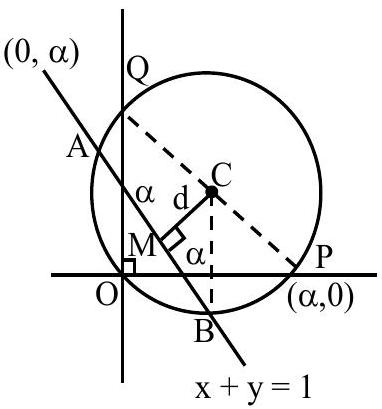
\end{itemize}
[CHAPTER M22 INTEGRATION TOPIC T2 ]
\begin{itemize}
\item[25.] If $\alpha=\int_{0}^{2 \sqrt{3}} \log _{2}\left(\mathrm{x}^{2}+4\right) \mathrm{dx}+\int_{2}^{4} \sqrt{2^{\mathrm{x}}-4} \mathrm{dx}$, then $\alpha^{2}$ is equal to $\_\_\_\_$. [JEE MAIN 02 April 2026 S I]
\end{itemize}Ans.(192)
\begin{itemize}
\item[] Sol. As we know that $\int_{\mathrm{a}}^{\mathrm{b}} \mathrm{f}(\mathrm{x}) \mathrm{dx}+\int_{\mathrm{f}(\mathrm{a})}^{\mathrm{f}(\mathrm{b})} \mathrm{f}^{-1}(\mathrm{x}) \mathrm{dx}=\mathrm{bf}(\mathrm{b})-\mathrm{af}(\mathrm{a})$\[ \therefore \alpha=(2 \sqrt{3})(4)-(0)(2)=8 \sqrt{3} \Rightarrow \alpha^{2}=192 \]\end{itemize}
- You must be logged in to reply to this topic.