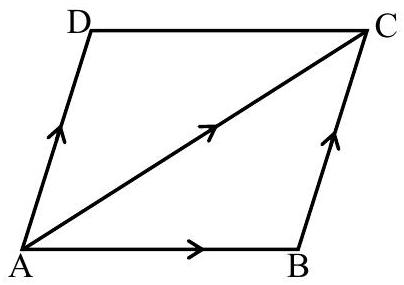
Let $\overrightarrow{\mathrm{AB}}=2 \hat{\mathrm{i}}+4 \hat{\mathrm{j}}-5 \hat{\mathrm{k}}$ and $\overrightarrow{\mathrm{AD}}=\hat{\mathrm{i}}+2 \hat{\mathrm{j}}+\lambda \hat{\mathrm{k}}, \lambda \in \mathrm{R}$. Let the projection of the vector $\overrightarrow{\mathrm{v}}=\hat{\mathrm{i}}+\hat{\mathrm{j}}+\hat{\mathrm{k}}$ on the diagonal $\overrightarrow{\mathrm{AC}}$ of the parallelogram ABCD be of length one unit. If $\alpha, \beta$, where $\alpha>\beta$, be the roots of the equation $\lambda^{2} \mathrm{x}^{2}-6 \lambda \mathrm{x}+5=0$, then $2 \alpha-\beta$ is equal to
[JEE MAIN 22 Jan 2026 S I]
(1) 1
(2) 4
(3) 3
(4) 6

.