- This topic has 1 reply, 1 voice, and was last updated 3 months, 1 week ago by
.
- You must be logged in to reply to this topic.
 shahkb4.
If the distances of the point $(1,2, a)$ from the line $\frac{x-1}{1}=\frac{y}{2}=\frac{z-1}{1}$
along the line $\mathrm{L}_{1}: \frac{\mathrm{x}-1}{3}=\frac{\mathrm{y}-2}{4}=\frac{\mathrm{z}-\mathrm{a}}{\mathrm{b}}$ and $\mathrm{L}_{2}: \frac{\mathrm{x}-1}{1}=\frac{\mathrm{y}-2}{4}=\frac{\mathrm{z}-\mathrm{a}}{\mathrm{c}}$ are equal, then $\mathrm{a}+\mathrm{b}+\mathrm{c}$ is equal to
[JEE MAIN 28 Jan 2026 S I]
(1) 7
(2) 5
(3) 6
(4) 4
Point $\mathrm{B}(3 \lambda+1,4 \lambda+2, \mathrm{~b} \lambda+\mathrm{a})$ on line $\mathrm{L}_{1}$
It also lies on given line L
$\frac{3 \lambda+1-1}{1}=\frac{4 \lambda+2}{2}=\frac{\mathrm{b} \lambda+\mathrm{a}-1}{1}$
$\Rightarrow 3 \lambda=2 \lambda+1=\mathrm{b} \lambda+\mathrm{a}-1$
$\Rightarrow \lambda=1,3=\mathrm{b}+\mathrm{a}-1 \Rightarrow \mathrm{a}+\mathrm{b}=4$
$B(4,6, a+b) \equiv B(4,6,4)$
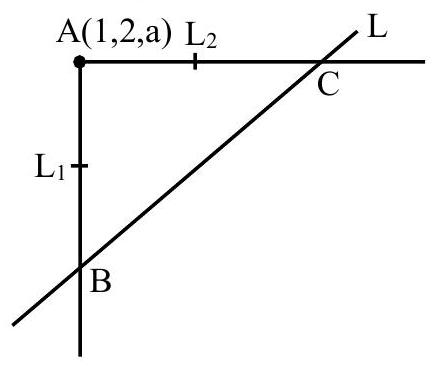
similarly Point C lies on $\mathrm{L}_{2}$
$c(\mu+1,4 \mu+2, c \mu+a)$
It lies on line L also
$\frac{\mu+1-1}{1}=\frac{4 \mu+2}{2}=\frac{\mathrm{c} \mu+\mathrm{a}-1}{1}$
$\Rightarrow \mu=2 \mu+1=\mathrm{c} \mu+\mathrm{a}-1$
$\Rightarrow \mu=-1$ and $\mathrm{a}=\mathrm{c}$
$\mathrm{C}(0,-2, \mathrm{a}-\mathrm{c}) \equiv \mathrm{C}(0,-2,0)$
$\because \mathrm{AB}=\mathrm{AC} \Rightarrow \mathrm{AB}^{2}=\mathrm{AC}^{2}$
$\Rightarrow 3^{2}+4^{2}+(\mathrm{a}-4)^{2}=1^{2}+4^{2}+\mathrm{a}^{2}$
$\Rightarrow 8+\mathrm{a}^{2}-8 \mathrm{a}+16=\mathrm{a}^{2}$
$\Rightarrow 89=24 \Rightarrow \mathrm{a}=3=\mathrm{c}, \mathrm{b}=1$
$\therefore \mathrm{a}+\mathrm{b}+\mathrm{c}=7$ Answer(1)