
EMI
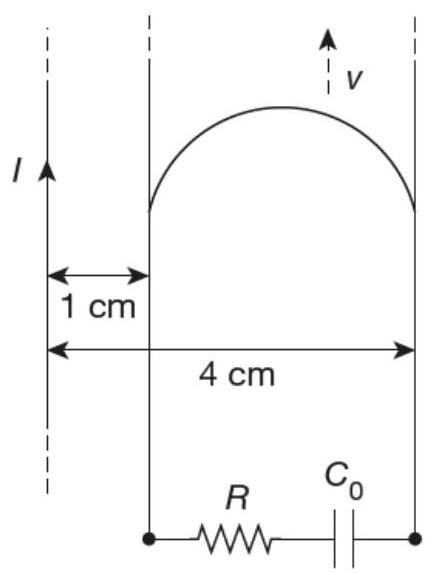
Question: A long straight wire carries a current,  ampere. A semi-circular conducting rod is placed beside it on two conducting parallel rails of negligible resistance. Both the rails are parallel to the wire. The wire, the rod and the rails lie in the same horizontal plane, as shown in the figure. Two ends of the semi-circular rod are at distances 1 cm and 4 cm from the wire. At time
  , the rod starts moving on the rails with a speed
  (see the figure).
A resistor  and a capacitor
  are connected in series between the rails. At time
  is uncharged. Which of the following statement(s) is(are) correct?
[  SI units. Take
  ]
]
(a) Maximum current through  is
is  ampere
(b) Maximum current through is  ampere
(c) Maximum charge on capacitor  is
is  coulomb (d) Maximum charge on capacitor
  is
is  coulomb
Answer: a c
Solution:
At first we will estimate the emf develop in the semi circular rod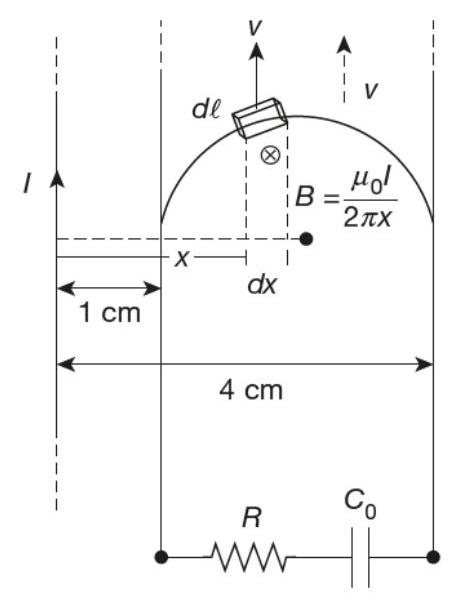

 (Towards left in segment)
![\varepsilon=\frac{\mu_{0} I V}{2 \pi}[\ln x]<em>{1}^{4}](https://pyq.upliftjee.com/wp-content/ql-cache/quicklatex.com-4c0e13a3601b3803e786a19e84a83db2_l3.svg "Rendered by QuickLaTeX.com")

 (This emf is in anticlockwise sense)
In this question further it is assumed that the velocity of rod is constant through out.
Now the given circuit is as like RC charging circuit
Given 

Maximum current at 
 (A correct)
Maximum charge at steady state ( ) 
Ans AC

 are connected in series between the rails. At time
  is uncharged. Which of the following statement(s) is(are) correct? [
  SI units. Take