demo

I=-\cot x \operatorname{cosec}^{3} x+\int \cot x\left(-3 \operatorname{cosec}^{2} x \cot x \operatorname{cosec} x\right) d x

\section*{Topic I: Indefinite Integration}
1. If \int \operatorname{cosec}^{5} x d x=\alpha \cot x \operatorname{cosec} x\left(\operatorname{cosec}^{2} x+\frac{3}{2}\right)+\beta \log _{e}\left|\tan \frac{x}{2}\right|+C where \alpha, \beta \in R and C is the constant of integration, then the value of 8(\alpha+\beta) equals \qquad .

[JEE (Main) 4 April 2024 S II]
Sol.(1) \int \operatorname{cosec}^{3} x \cdot \operatorname{cosec}^{2} x d x=1

By applying integration by parts
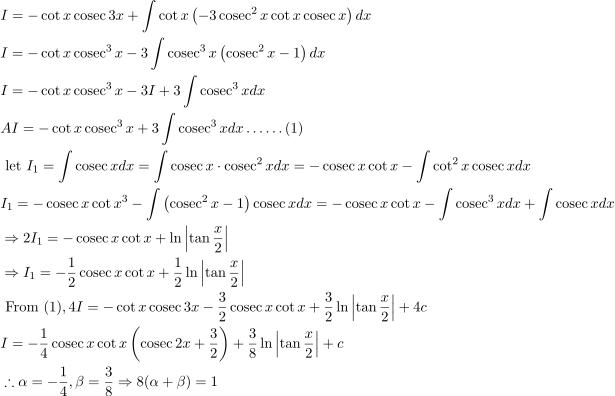
I=-\cot x \operatorname{cosec}^{3} x+\int \cot x\left(-3 \operatorname{cosec}^{2} x \cot x \operatorname{cosec} x\right) d x
I=-\cot x \operatorname{cosec}^{3} x-3 \int \operatorname{cosec}^{3} x\left(\operatorname{cosec}^{2} x-1\right) d x
I=-\cot x \operatorname{cosec}^{3} x-31+3 \int \operatorname{cosec}^{3} x d x
4 I=-\cot x \operatorname{cosec}^{3} x+3 \int \operatorname{cosec}^{3} x d x.
let \mathrm{I}_{1}=\int \operatorname{cosec}^{3} \mathrm{x} d \mathrm{dx}=\int \operatorname{cosec} x \cdot \operatorname{cosec}^{2} \mathrm{x} \mathrm{dx}=-\operatorname{cosec} x \cot \mathrm{x}-\int \cot ^{2} \mathrm{x} \operatorname{cosec} \mathrm{xdx}
I_{1}=-\operatorname{cosec} x \cot x-\int\left(\operatorname{cosec}^{2} x-1\right) \operatorname{cosec} x d x=-\operatorname{cosec} x \cot x-\int \operatorname{cosec}^{3} x d x+\int \operatorname{cosec} x d x
\Rightarrow 21_{1}=-\operatorname{cosec} x \cot x+\ln \left|\tan \frac{x}{2}\right|
\Rightarrow I_{1}=-\frac{1}{2} \operatorname{cosec} x \cot x+\frac{1}{2} \ln \left|\tan \frac{x}{2}\right|
From (1), 4 I=-\cot x \operatorname{cosec}^{3} x-\frac{3}{2} \operatorname{cosec} x \cot x+\frac{3}{2} \ln \left|\tan \frac{x}{2}\right|+4 c
I=-\frac{1}{4} \operatorname{cosec} x \cot x\left(\operatorname{cosec}^{2} x+\frac{3}{2}\right)+\frac{3}{8} \ln \left|\tan \frac{x}{2}\right|+c
\therefore \alpha=-\frac{1}{4}, \beta=\frac{3}{8} \Rightarrow 8(\alpha+\beta)=1

\begin{aligned} & I=-\cot x \operatorname{cosec} 3 x+\int \cot x\left(-3 \operatorname{cosec}^2 x \cot x \operatorname{cosec} x\right) d x \\ & I=-\cot x \operatorname{cosec}^3 x-3 \int \operatorname{cosec}^3 x\left(\operatorname{cosec}^2 x-1\right) d x \\ & I=-\cot x \operatorname{cosec}^3 x-3 I+3 \int \operatorname{cosec}^3 x d x \\ & A I=-\cot x \operatorname{cosec}^3 x+3 \int \operatorname{cosec}^3 x d x \ldots \ldots(1) \\ & \text { let } I_1=\int \operatorname{cosec} x d x=\int \operatorname{cosec} x \cdot \operatorname{cosec}^2 x d x=-\operatorname{cosec} x \cot x-\int \cot ^2 x \operatorname{cosec} x d x \\ & I_1=-\operatorname{cosec} x \cot x^3-\int\left(\operatorname{cosec}^2 x-1\right) \operatorname{cosec} x d x=-\operatorname{cosec} x \cot x-\int \operatorname{cosec}^3 x d x+\int \operatorname{cosec} x d x \\ & \Rightarrow 2 I_1=-\operatorname{cosec} x \cot x+\ln \left|\tan \frac{x}{2}\right| \\ & \Rightarrow I_1=-\frac{1}{2} \operatorname{cosec} x \cot x+\frac{1}{2} \ln \left|\tan \frac{x}{2}\right| \\ & \text { From }(1), 4 I=-\cot x \operatorname{cosec} 3 x-\frac{3}{2} \operatorname{cosec} x \cot x+\frac{3}{2} \ln \left|\tan \frac{x}{2}\right|+4 c \\ & I=-\frac{1}{4} \operatorname{cosec} x \cot x\left(\operatorname{cosec} 2 x+\frac{3}{2}\right)+\frac{3}{8} \ln \left|\tan \frac{x}{2}\right|+c \\ & \therefore \alpha=-\frac{1}{4}, \beta=\frac{3}{8} \Rightarrow 8(\alpha+\beta)=1\end{aligned}

3. Let \mathrm{I}(\mathrm{x})=\int \frac{6}{\sin ^{2} \mathrm{x}(1-\cot \mathrm{x})^{2}} d \mathrm{x}. If \mathrm{I}(0)=3, then \mathrm{I}\left(\frac{\pi}{12}\right) is equal to
(A) 2 \sqrt{3}
(B) 6 \sqrt{3}
(C) \sqrt{3}
(D) 3 \sqrt{3}

Sol.(D) I(x)=\int \frac{6 d x}{\sin ^{2} x(1-\cot x)^{2}}=\int \frac{6 \operatorname{cosec}^{2} x d x}{(1-\cot x)^{2}}
Put 1-\cot \mathrm{x}=\mathrm{t} \Rightarrow \operatorname{cosec}^{2} \mathrm{xdx}=\mathrm{dt}
I=\int \frac{6 \mathrm{dt}}{\mathrm{t}^{2}}=-\frac{6}{\mathrm{t}}+\mathrm{c}
I(x)=-\frac{6}{1-\cot x}+c
\mathrm{I}(0)=-\frac{6}{\infty}+\mathrm{C}=3 \Rightarrow \mathrm{C}=3

    \[ \begin{aligned} & I(x)=3-\frac{6}{1-\cot x} \\ & I\left(\frac{\pi}{12}\right)=3-\frac{6}{1-(2+\sqrt{3})}=3+\frac{6}{\sqrt{3}+1}=3+\frac{6(\sqrt{3}-1)}{2}=3 \sqrt{3} \end{aligned}\]


4. If \int \frac{1}{\sqrt[5]{(x-1)^{4}(x+3)^{6}}} d x=A\left(\frac{\alpha x-1}{\beta x+3}\right)^{B}+C, where C is the constant of integration, then the value of \alpha+\beta+20 \mathrm{AB} is \qquad
[JEE (Main) 8 April 2024 S II]
Sol.(7) \int \frac{1}{\sqrt[5]{(x-1)^{4}(x+3)^{6}}} d x=\int \frac{1}{\left(\frac{x-1}{x+3}\right)^{4 / 5}(x+3)^{2}} d x
\operatorname{Put}\left(\frac{x-1}{x+3}\right)=t \Rightarrow \frac{4}{(x+3)^{2}} d x=d t
\mathrm{I}=\frac{1}{4} \int \frac{1}{\mathrm{t}^{4 / 5}} \mathrm{dt}=\frac{1}{4} \frac{\mathrm{t}^{1 / 5}}{1 / 5}+\mathrm{C}=\frac{5}{4}\left(\frac{\mathrm{x}-1}{\mathrm{x}+3}\right)^{1 / 5}+\mathrm{C}
\mathrm{A}=\frac{5}{4}, \alpha=\beta=1, \mathrm{~B}=\frac{1}{5}
\alpha+\beta+20 \mathrm{AB}=2+20 \times \frac{5}{4} \times \frac{1}{5}=7
5. Let \int \frac{2-\tan x}{3+\tan x} d x=\frac{1}{2}\left(\alpha x+\log _{e}|\beta \sin x+\gamma \cos x|\right)+C, where C is the constant of integration. Then \alpha+\frac{\gamma}{\beta} is equal to
[JEE (Main) 9 April 2024 S I]
(A) 1
(B) 7
(C) 4
(D) 3

Sol.(C) \int \frac{2-\tan x}{3+\tan x} d x=\int \frac{2 \cos x-\sin x}{3 \cos x+\sin x} d x

2 \cos x-\sin x=A(3 \cos x+\sin x)+B(\cos x-3 \sin x)
\Rightarrow 2 \cos \mathrm{x}-\sin \mathrm{x}=\cos (3 \mathrm{~A}+\mathrm{B})+\sin \mathrm{x}(\mathrm{A}-3 \mathrm{~B})
3 \mathrm{~A}+\mathrm{B}=2 and \mathrm{A}-3 \mathrm{~B}=-1
\Rightarrow \mathrm{A}=\frac{1}{2}, \mathrm{~B}=\frac{1}{2}
\therefore \int \frac{2 \cos x-\sin x}{3 \cos x+\sin x} d x=\int \frac{1}{2}+\frac{1}{2} \frac{\cos x-3 \sin x}{3 \cos x+\sin x}
=\frac{1}{2}(\mathrm{x}+\ln |3 \cos \mathrm{x}+\sin \mathrm{x}|)+\mathrm{C}
we get \alpha=1, \beta=1, \gamma=3
\therefore \alpha+\frac{\gamma}{\beta}=1+\frac{3}{1}=4

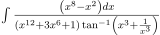
6. The integral \int \frac{\left(x^{8}-x^{2}\right) d x}{\left(x^{12}+3 x^{6}+1\right) \tan ^{-1}\left(x^{3}+\frac{1}{x^{3}}\right)} is equal to :
(A) \log _{e}\left(\left|\tan ^{-1}\left(x^{3}+\frac{1}{x^{3}}\right)\right|\right)^{1 / 3}+C
(B) \log _{e}\left(\left|\tan ^{-1}\left(x^{3}+\frac{1}{x^{3}}\right)\right|\right)^{1 / 2}+C
(C) \log _{e}\left(\left|\tan ^{-1}\left(x^{3}+\frac{1}{x^{3}}\right)\right|\right)+C
(D) \log _{e}\left(\left|\tan ^{-1}\left(x^{3}+\frac{1}{x^{3}}\right)\right|\right)^{3}+C

Sol.(A) Let \tan ^{-1}\left(x^{3}+\frac{1}{x^{3}}\right)=t \Rightarrow \frac{1}{1+\left(x^{3}+\frac{1}{x^{3}}\right)^{2}} \cdot\left(3 x^{2}-\frac{3}{x^{4}}\right) d x=d t
\Rightarrow \frac{x^{6}}{x^{12}+3 x^{6}+1} \cdot \frac{3 x^{6}-3}{x^{4}} d x=d t \Rightarrow \frac{\left(x^{8}-x^{2}\right)}{\left(x^{12}+3 x^{6}+1\right)} d x=\frac{d t}{3}
I=\frac{1}{3} \int \frac{d t}{t}=\frac{1}{3} \ln |t|+C=\frac{1}{3} \log _{\mathrm{e}}\left|\tan ^{-1}\left(x^{3}+\frac{1}{x^{3}}\right)\right|+C
I=\log _{\mathrm{e}}\left|\tan ^{-1}\left(x^{3}+\frac{1}{x^{3}}\right)\right|^{1 / 3}+C
Hence option (A) is correct

6. The integral \int \frac{\left(x^{8}-x^{2}\right) d x}{\left(x^{12}+3 x^{6}+1\right) \tan ^{-1}\left(x^{3}+\frac{1}{x^{3}}\right)} is equal to :
(A) \log _{e}\left(\left|\tan ^{-1}\left(x^{3}+\frac{1}{x^{3}}\right)\right|\right)^{1 / 3}+C
(B) \log _{e}\left(\left|\tan ^{-1}\left(x^{3}+\frac{1}{x^{3}}\right)\right|\right)^{1 / 2}+C
(C) \log _{e}\left(\left|\tan ^{-1}\left(x^{3}+\frac{1}{x^{3}}\right)\right|\right)+C
(D) \log _{e}\left(\left|\tan ^{-1}\left(x^{3}+\frac{1}{x^{3}}\right)\right|\right)^{3}+C

Sol.(A) Let \tan ^{-1}\left(x^{3}+\frac{1}{x^{3}}\right)=t \Rightarrow \frac{1}{1+\left(x^{3}+\frac{1}{x^{3}}\right)^{2}} \cdot\left(3 x^{2}-\frac{3}{x^{4}}\right) d x=d t
\Rightarrow \frac{x^{6}}{x^{12}+3 x^{6}+1} \cdot \frac{3 x^{6}-3}{x^{4}} d x=d t \Rightarrow \frac{\left(x^{8}-x^{2}\right)}{\left(x^{12}+3 x^{6}+1\right)} d x=\frac{d t}{3}
I=\frac{1}{3} \int \frac{d t}{t}=\frac{1}{3} \ln |t|+C=\frac{1}{3} \log _{\mathrm{e}}\left|\tan ^{-1}\left(x^{3}+\frac{1}{x^{3}}\right)\right|+C
I=\log _{\mathrm{e}}\left|\tan ^{-1}\left(x^{3}+\frac{1}{x^{3}}\right)\right|^{1 / 3}+C
Hence option (A) is correct
7. For x \in\left(-\frac{\pi}{2}, \frac{\pi}{2}\right), if y(x)=\int \frac{\operatorname{cosec} x+\sin x}{\operatorname{cosec} x \sec x+\tan x \sin ^{2} x} d x and \lim _{x \rightarrow \frac{\pi^{-}}{2}} y(x)=0 then y\left(\frac{\pi}{4}\right) is equal to

6. The integral \int \frac{\left(x^{8}-x^{2}\right) d x}{\left(x^{12}+3 x^{6}+1\right) \tan ^{-1}\left(x^{3}+\frac{1}{x^{3}}\right)} is equal to :
(A) \log _{e}\left(\left|\tan ^{-1}\left(x^{3}+\frac{1}{x^{3}}\right)\right|\right)^{1 / 3}+C
(B) \log _{e}\left(\left|\tan ^{-1}\left(x^{3}+\frac{1}{x^{3}}\right)\right|\right)^{1 / 2}+C
(C) \log _{e}\left(\left|\tan ^{-1}\left(x^{3}+\frac{1}{x^{3}}\right)\right|\right)+C
(D) \log _{e}\left(\left|\tan ^{-1}\left(x^{3}+\frac{1}{x^{3}}\right)\right|\right)^{3}+C

Sol.(A) Let \tan ^{-1}\left(x^{3}+\frac{1}{x^{3}}\right)=t \Rightarrow \frac{1}{1+\left(x^{3}+\frac{1}{x^{3}}\right)^{2}} \cdot\left(3 x^{2}-\frac{3}{x^{4}}\right) d x=d t
\Rightarrow \frac{x^{6}}{x^{12}+3 x^{6}+1} \cdot \frac{3 x^{6}-3}{x^{4}} d x=d t \Rightarrow \frac{\left(x^{8}-x^{2}\right)}{\left(x^{12}+3 x^{6}+1\right)} d x=\frac{d t}{3}
I=\frac{1}{3} \int \frac{d t}{t}=\frac{1}{3} \ln |t|+C=\frac{1}{3} \log _{\mathrm{e}}\left|\tan ^{-1}\left(x^{3}+\frac{1}{x^{3}}\right)\right|+C
I=\log _{\mathrm{e}}\left|\tan ^{-1}\left(x^{3}+\frac{1}{x^{3}}\right)\right|^{1 / 3}+C
Hence option (A) is correct
7. For x \in\left(-\frac{\pi}{2}, \frac{\pi}{2}\right), if y(x)=\int \frac{\operatorname{cosec} x+\sin x}{\operatorname{cosec} x \sec x+\tan x \sin ^{2} x} d x and \lim _{x \rightarrow \frac{\pi^{-}}{2}} y(x)=0 then y\left(\frac{\pi}{4}\right) is equal to
[JEE (Main) 29 Jan 2024 S I]
(A) -\frac{1}{\sqrt{2}} \tan ^{-1}\left(\frac{1}{\sqrt{2}}\right)
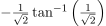
(B) \tan ^{-1}\left(\frac{1}{\sqrt{2}}\right)
(C) \frac{1}{\sqrt{2}} \tan ^{-1}\left(-\frac{1}{2}\right)
(D) \frac{1}{2} \tan ^{-1}\left(\frac{1}{\sqrt{2}}\right)

Sol.(C) y(x)=\int \frac{\left(1+\sin ^{2} x\right) \cos x}{1+\sin ^{4} x} d x Put \sin x=t, \cos x=d t

    \[ \begin{aligned} & y(x)=\int \frac{1+t^{2}}{t^{4}+1} d t=\int \frac{\frac{1}{t^{2}}+1}{\left(t-\frac{1}{t}\right)^{2}+2} d t=\frac{1}{\sqrt{2}} \tan ^{-1} \frac{\left(t-\frac{1}{t}\right)}{\sqrt{2}}+C \\ & y(x)=\frac{1}{\sqrt{2}} \tan ^{-1}\left(\frac{\sin x-\operatorname{cosec} x}{\sqrt{2}}\right)+C \end{aligned}\]


\lim _{\pi^{-}} y(x)=0=0+c \Rightarrow c=0
x \rightarrow \frac{\pi^{-}}{2}
y\left(\frac{\pi}{4}\right)=\frac{1}{\sqrt{2}} \tan ^{-1}\left(-\frac{1}{2}\right)

NEW

Sol.(B) I=\int \frac{\sin ^{3 / 2} x+\cos ^{3 / 2} x}{\sqrt{\sin ^{3} x \cos ^{3} x \sin (x-\theta)}} d x
I=\int \frac{\sin ^{3 / 2} x+\cos ^{3 / 2} x}{\sqrt{\sin ^{3} x \cos ^{3} x(\sin x \cos \theta-\cos x \sin \theta)}} d x
I=\int \frac{\sin ^{3 / 2} x}{\sin ^{3 / 2} x \cos ^{2} x \sqrt{\tan x \cos \theta-\sin \theta}} d x+\int \frac{\cos ^{3 / 2} x}{\sin ^{2} x \cos ^{3 / 2} x \sqrt{\cos \theta-\cot x \sin \theta}} d x
I=\int \frac{\sec ^{2} x}{\sqrt{\tan x \cos \theta-\sin \theta}} d x+\int \frac{\operatorname{cosec}^{2} x}{\sqrt{\cos \theta-\cot x \sin \theta}} d x
let \tan x \cos \theta-\sin \theta=t^{2} ; \sec ^{2} x d x=\frac{2 t d t}{\cos \theta}
let \cos \theta-\cot x \sin \theta=z^{2} ; \operatorname{cosec}^{2} x d x=\frac{2 z d z}{\sin \theta}
I=\int \frac{2 t d t}{t \cos \theta}+\int \frac{2 z d z}{z \sin \theta}=\frac{2 t}{\cos \theta}+\frac{2 z}{\sin \theta}
=2 \sec \theta \sqrt{\tan x \cos \theta-\sin \theta}+2 \operatorname{cosec} \theta \sqrt{\cos \theta-\cot x \sin \theta}
Comparing we have A=2 \sec \theta, B=2 \operatorname{cosec} \theta then A B=8 \operatorname{cosec} 2 \theta
9. Let f(x)=\int \frac{2 x}{\left(x^{2}+1\right)\left(x^{2}+3\right)} d x. If f(3)=1 / 2\left(\log _{e} 5-\log _{e} 6\right), then f(4) is equal to
[JEE (Main) 25 Jan 2023 S I]
(A) 1 / 2\left(\log _{e} 19-\log _{e} 17\right) (B) \log _{e} 17-\log _{e} 18

(C) 1 / 2\left(\log _{e} 17-\log _{e} 19\right)(D) \log _{e} 19-\log _{e} 20

Sol.(C) Put \mathrm{x}^{2}=\mathrm{t}=2 \mathrm{xdx}=\mathrm{dt}
f(x)=\int \frac{d t}{(t+1)(t+3)}=\frac{1}{2} \int\left(\frac{1}{t+1}-\frac{1}{t+3}\right) d t
f(x)=\frac{1}{2}[\log (t+1)-\log (t+3)]+C
f(x)=\frac{1}{2}\left[\log \left(x^{2}+1\right)-\log \left(x^{2}+3\right)\right]+C
put x=3, f(3)=\frac{1}{2}(\ln 10-\ln 12)+C \Rightarrow C=0
f(4)=\frac{1}{2} \ln \left(\frac{17}{19}\right)

Similar Posts

Leave a Reply