
- This topic has 1 reply, 1 voice, and was last updated 3 months, 1 week ago by
shahkb4.
-
AuthorPosts
-
Let the line L pass through the point $(-3,5,2)$ and make equal angles with the positive coordinate axes. If the distance of L from the point $(-2, \mathrm{r}, 1)$ is $\sqrt{\frac{14}{3}}$, then the sum of all possible values of $r$ is
[JEE MAIN 21 Jan 2026 S II]
(1) 12
(2) 16
(3) 6
(4) 10Solution
\[ \begin{aligned} & \alpha=\beta=\gamma \\ & \cos ^{2} \alpha+\cos ^{2} \beta+\cos ^{2} \gamma=1 \\ & \Rightarrow 3 \cos ^{2} \alpha=1 \Rightarrow \cos \alpha=\frac{1}{\sqrt{3}} \end{aligned} \]direction ratios $\rightarrow 1,1,1$
line $\frac{x+3}{1}=\frac{y-5}{1}=\frac{z-2}{1}=\lambda$
$\mathrm{B}(\lambda-3, \lambda+5, \lambda+2)$
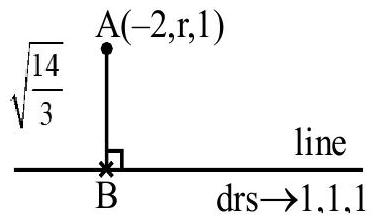
$\mathrm{AB} \xrightarrow{\text { drs }} \lambda-3+2, \lambda+5-\mathrm{r}, \lambda+2-1$ or $\lambda-1, \lambda+5-\mathrm{r}, \lambda+1$
line $\xrightarrow{\text { drs }} 1,1,1$
line $\perp \mathrm{AB} \Rightarrow(\lambda-1) 1+(\lambda+5-\mathrm{r}) 1+(\lambda+1) 1=0$
$\Rightarrow \lambda=\frac{\mathrm{r}-5}{3}$
$\mathrm{B}(\lambda-3, \lambda+5, \lambda+2) \equiv\left(\frac{\mathrm{r}-14}{3}, \frac{\mathrm{r}+10}{3}, \frac{\mathrm{r}+1}{3}\right)$
A(-2,r,1)
$\mathrm{AB}^{2}=\frac{14}{3} \Rightarrow\left(\frac{\mathrm{r}-14}{3}+2\right)^{2}+\left(\frac{\mathrm{r}+10}{3}-\mathrm{r}\right)^{2}+\left(\frac{\mathrm{r}+1}{3}-1\right)^{2}=\frac{14}{3}$
$\Rightarrow\left(\frac{\mathrm{r}-8}{3}\right)^{2}+\left(\frac{10-2 \mathrm{r}}{3}\right)^{2}+\left(\frac{\mathrm{r}-2}{3}\right)^{2}=\frac{14}{3}$
$\Rightarrow \mathrm{r}^{2}+64-16 \mathrm{r}+100+4 \mathrm{r}^{2}-40 \mathrm{r}+\mathrm{r}^{2}-4 \mathrm{r}+4=14 \times 3=42$
$\Rightarrow 6 \mathrm{r}^{2}-60 \mathrm{r}+12 \mathrm{r}=0 \Rightarrow \mathrm{r}^{2}-10 \mathrm{r}+21=0$
$\Rightarrow(\mathrm{r}-7)(\mathrm{r}-3)=0 \Rightarrow \mathrm{r}=7,3$ Sum $=10$ Answer(4) -
AuthorPosts

- You must be logged in to reply to this topic.