- This topic has 1 reply, 1 voice, and was last updated 3 months, 1 week ago by
.
- You must be logged in to reply to this topic.
 shahkb4.
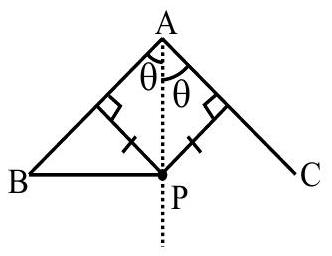
Let P be a point in the plane of the vector $\overrightarrow{\mathrm{AB}}=3 \hat{\mathrm{i}}+\hat{\mathrm{j}}-\mathrm{k}$ and $\overrightarrow{\mathrm{AC}}=\hat{\mathrm{i}}-\hat{\mathrm{j}}+3 \mathrm{k}$
such that P is equidistant from the lines AB and AC . If $|\overrightarrow{\mathrm{AP}}|=\frac{\sqrt{5}}{2}$,
then the area of the triangle ABP is
[JEE MAIN 28 Jan 2026 S II]
(1) 2
(2) $\frac{3}{2}$
(3) $\frac{\sqrt{30}}{4}$
(4) $\frac{\sqrt{26}}{4}$
As P is equidistant from lines AB and AC . It means P lies on angle bisector $\angle \mathrm{BAC}$